

TRIESTE – In the ports of Trieste and Monfalcone, the port labour model recorded broad growth in 2025, with rising indicators and an improvement in safety.
The data from the Trieste Port Labour Agency (ALPT) and Monfalcone’s Impresa Alto Adriatico highlight a strengthening of the system based on Art. 17 of Law 84 of 1994, which ensures the supply of labour in the two ports.
In employment terms, Trieste counts 201 employees and 56 temporary agency workers. In Monfalcone, following ministerial authorisation, the workforce rose from 85 to 107 employees, with a further 18 temporary agency workers. The total number of shifts also grew sharply, rising from 66,700 in 2024 to 72,560 in 2025, an increase of nearly 9%. The rise was driven above all by Monfalcone, which jumped from 18,000 to 23,400 shifts (+30%), while Trieste remained at high volumes, with 49,160 shifts compared with 48,700 the previous year.
The trend in training is particularly significant. Dedicated shifts rose from 2,037 in 2024 to 2,978 in 2025 (+46%), with a forecast of more than 3,900 in 2026. The figure points to a structural investment in workforce qualification.
Safety also improved. Days lost due to injuries fell to 568 in 2025, compared with 679 in 2024 and 1,336 in 2019. The comparison with the 2021 peak of 1,841 days shows a reduction of more than two thirds. On the economic front, the system’s overall turnover reached 19.86 million euros, up 21% from 16.4 million in 2024. Trieste rose from 12 to 13.4 million (+12%), while Monfalcone recorded a sharper increase, from 4.4 to 6.46 million (+47%).
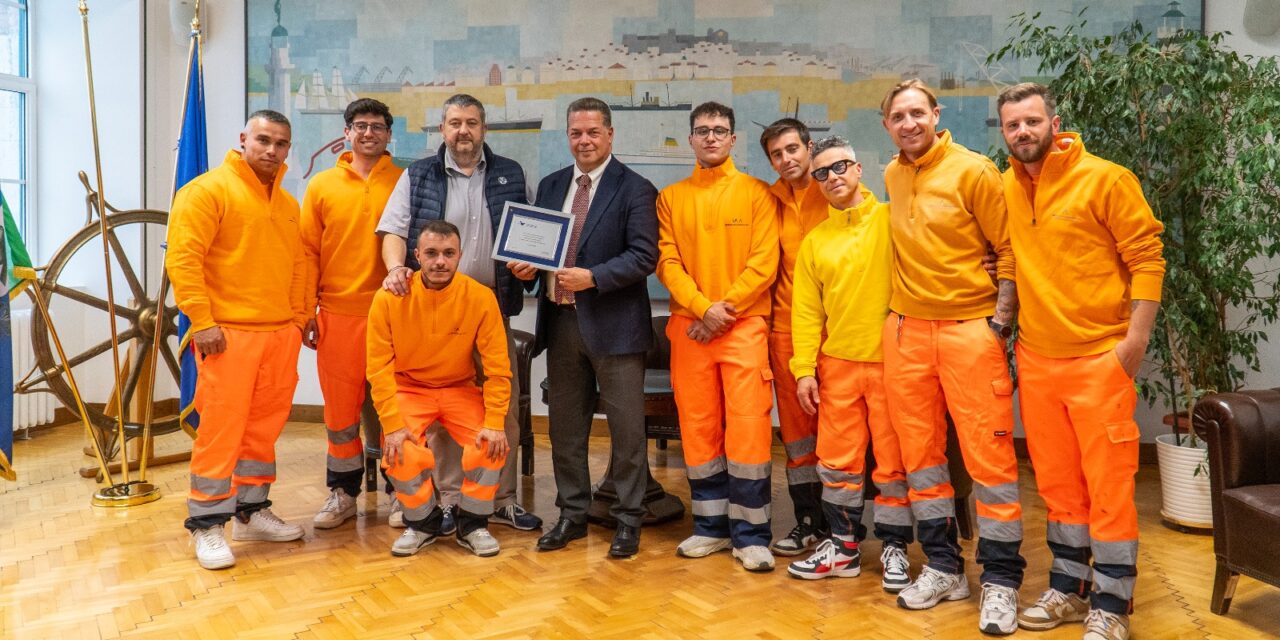
In light of these results, the president of the Port System Authority of the Eastern Adriatic Sea, Marco Consalvo, presented a recognition plaque to the Art. 17 workers of ALPT and Impresa Alto Adriatico.
«The results achieved by ALPT and Alto Adriatico are solid and confirm the quality of port labour in our ports, thanks to cooperation between companies, workers, trade unions and the Port System Authority. The contribution of companies operating under Articles 16 and 18 has also been decisive, as they generated the activity needed to achieve these results. But the most significant point is that Trieste and Monfalcone form a single system, a community of workers growing in a coordinated way. It is this cohesion – Consalvo said – that makes it possible to combine development and quality, while keeping safety, training and work organisation at the centre. The goal for the next two years is to consolidate the results achieved, continuing along a path that places labour at the centre as a competitive factor to strengthen the role of the two ports on international routes».