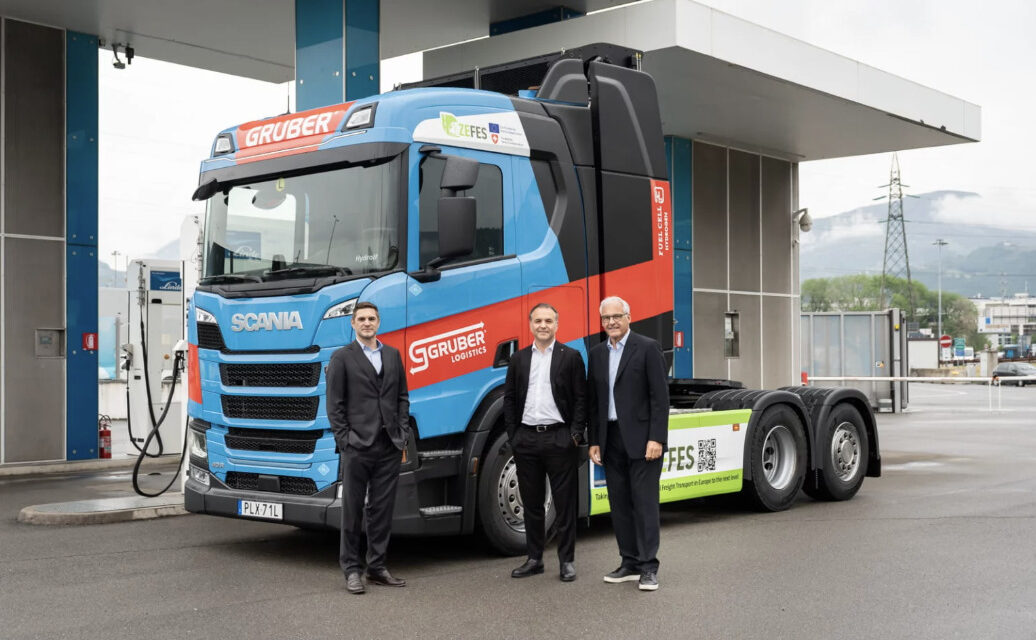


TRIESTE – Since May 2026, a Scania 40 R equipped with FCEV – Fuel Cell Electric Vehicle – technology has been operating on Italian roads. The initiative stems from an agreement with Gruber Logistics, as part of the European ZEFES (Zero Emission Freight EcoSystem) project dedicated to the decarbonisation of freight transport.
The vehicle is built on Scania’s BEV electric platform, integrated with four hydrogen tanks with a total capacity of 56 kg at 700 bar and a 300 kW fuel-cell system. Hydrogen is converted directly into electricity through the fuel cell, with a range of up to 1,000 km, of which 690 km on hydrogen and 310 km on battery power. Refuelling takes around 20 minutes, compared with the hours required to recharge fully electric vehicles.
The vehicle carries goods for leading customers in their respective sectors, such as Nestlé, Procter & Gamble, Verallia Italia, ABB and Birra Forst. «This is an important step in accelerating the deployment of new technologies and understanding from the outset the potential difficulties that a logistics operator has to face when using them», said Martin Gruber, CEO of Gruber Logistics.
Port terminals are among the nodes under the greatest pressure to decarbonise land transport, due to European regulations – led by FuelEU Maritime – and their proximity to urban areas. The ZEFES project includes refuelling tests, demonstrations and participation in industry events. The first appointment is Transpotec 2026 in Verona, where Scania and Gruber Logistics will present the initiative on 14 May. The vehicle will also be present at Gruber Logistics’ Innovation Summit in Bolzano: on 27 May at the Safety Park and on 28 May at NOI Techpark.
Gruber Logistics and Scania test fuel-cell truckThe project is part of the European ZEFES initiative and sees the vehicle used on operational routes with leading industrial customers