

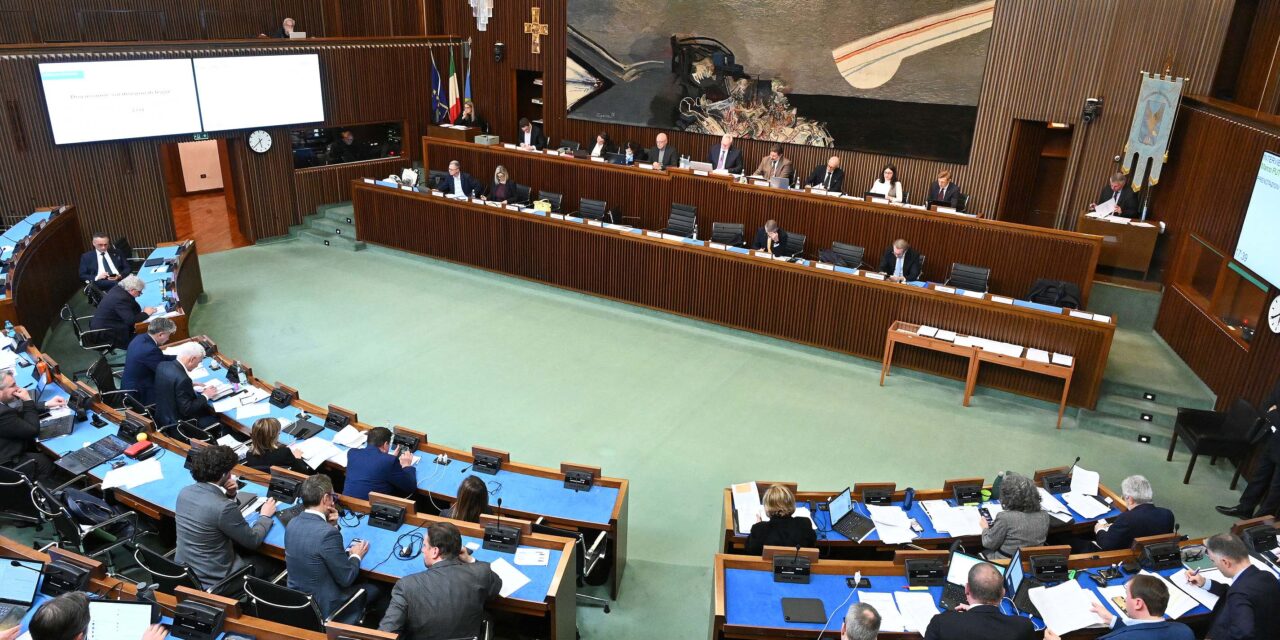
TRIESTE – The Friuli Venezia Giulia Region is introducing a specific regulatory framework to manage the expansion of logistics. Bill 71 was approved by the chamber with votes from the centre-right, while opposition parties split between abstention and voting against.
The measure aims to fill a regulatory gap in a fast-growing sector that, until now, has lacked an updated urban-planning framework. The law also classifies data centers as logistics facilities and introduces a distinction based on operational area. Hubs exceeding three hectares are defined as being of strategic regional interest. In these cases, a co-planning procedure between the Municipality and the Region is required, involving the new Regional Logistics Technical Group (Gtl), tasked with a multidisciplinary assessment of projects.
The co-planning agreement requires the developer to submit not only the planning proposal, but also a business plan demonstrating the investment’s economic and financial soundness, and a study of the residual capacity of the road network. The rule also sets out general criteria for locating new facilities: priority for redeveloping disused areas, proximity to key transport infrastructure, protection of public health and the landscape, and environmental mitigation measures.
During the debate in the chamber, several changes were introduced. Some amendments state that, for expansions exceeding the three-hectare threshold, the Gtl must issue an opinion within 60 days on compliance with the criteria set by the law. Even for smaller facilities, the Municipality will have to forward the documentation to the Region, in order to formally confirm that the co-planning procedure is not required.
An amendment submitted by the Infrastructure Councillor, Cristina Amirante, provides that, within 180 days of the law entering into force, the Regional Executive will define criteria and guidelines to identify the territorial areas suitable for logistics developments, after hearing the competent council commission.
The proposal to include the areas covered by Local Economic Development Consortia among the location principles was also approved. Lastly, the chamber gave the green light to the amendment that adds job creation among the elements used to assess the sustainability of interventions, and to the one requiring an annual—rather than biennial—report by the Gtl on the implementation status of logistics facilities.