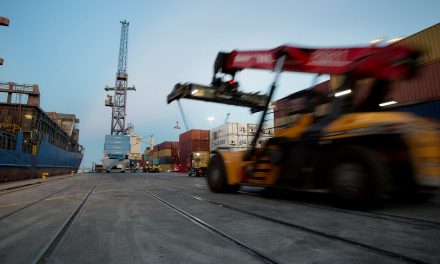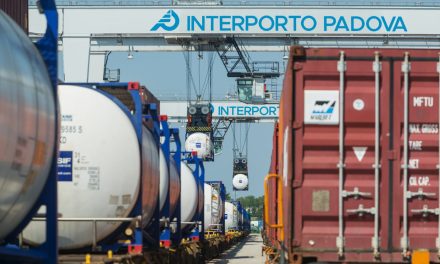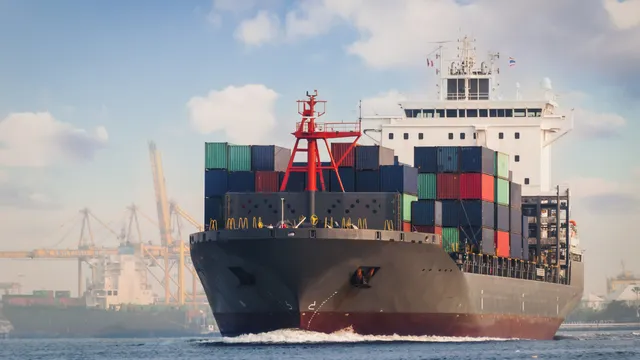


TRIESTE – New trade barriers and the return of protectionism are reshaping global shipping. Wars, tariffs, and international tensions are pushing supply chains toward deep reorganization, opening the way for alternative routes and regionalized trade flows. In this context, the Mediterranean is emerging as a key player, with ports becoming increasingly strategic and short sea shipping playing a growing role.
These are the main themes of the 2025 “Italian Maritime Economy” Report, presented yesterday in Naples by SRM, the research center of Intesa Sanpaolo.
In 2024, global seaborne trade grew by 2.1%, reaching 12.6 billion tonnes. Forecasts for the coming years remain cautious but positive, despite ongoing global economic uncertainty. The Mediterranean is helping to drive this recovery, having handled 62 million TEUs (+5.1%), showing remarkable adaptability in response to shifting international shipping routes.
Italy stands out as the leading European country for short sea shipping, moving 302 million tonnes out of nearly 628 million across the Mediterranean. This leadership reflects both the efficiency of Italy’s short-range maritime links and the dynamism of its ports.
The Suez Canal, heavily affected by the Red Sea crises, has seen traffic drop sharply: -18% in the first five months of 2025 compared to the previous year, and -70% compared to 2023.
However, SRM notes that some carriers are gradually returning to this route, suggesting a possible rebalancing in the near future.
Meanwhile, new trade corridors are gaining momentum. The IMEC corridor — the so-called “Cotton Route” — promoted by the United States as an alternative to China’s Belt and Road Initiative, could channel up to €200 billion in trade between India, the Middle East, and Europe. It’s a direct response to the decoupling among major global economies, boosting regional routes and reducing reliance on large Asian hubs.
Evidence of this global shift is already emerging: according to SRM, China has lost its position as the top exporter to the U.S. after 17 years, overtaken by Mexico. Chinese imports to the U.S. have declined by 9% over the past decade, signaling a structural change in global trade flows.
Ports are also evolving in terms of energy.
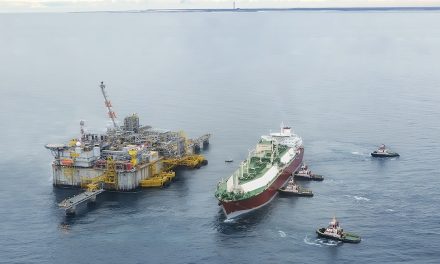
More and more often, they serve as key nodes for infrastructure tied to the green transition: pipeline terminals, logistics centers for alternative fuels, and hubs for renewables. LNG remains the preferred option among shipowners (36.8%), but methanol use is on the rise.
Italy, with an export+import-to-GDP ratio of 54.3%, is among the world’s most open economies. The United States is Italy’s top export destination and second-largest import source, after China. Italian ports are keeping pace: 481 million tonnes of cargo handled in 2024 (+0.7%), with strong performance in container traffic (11.7 million TEUs, +6.5%).
To face future challenges, investment in integrated and sustainable logistics models will be crucial. The 2025 Economic and Financial Document (DEF) allocates €12.5 billion for port intermodality and innovation: a vital push to ensure competitiveness and attract new trade flows in the evolving global market.