

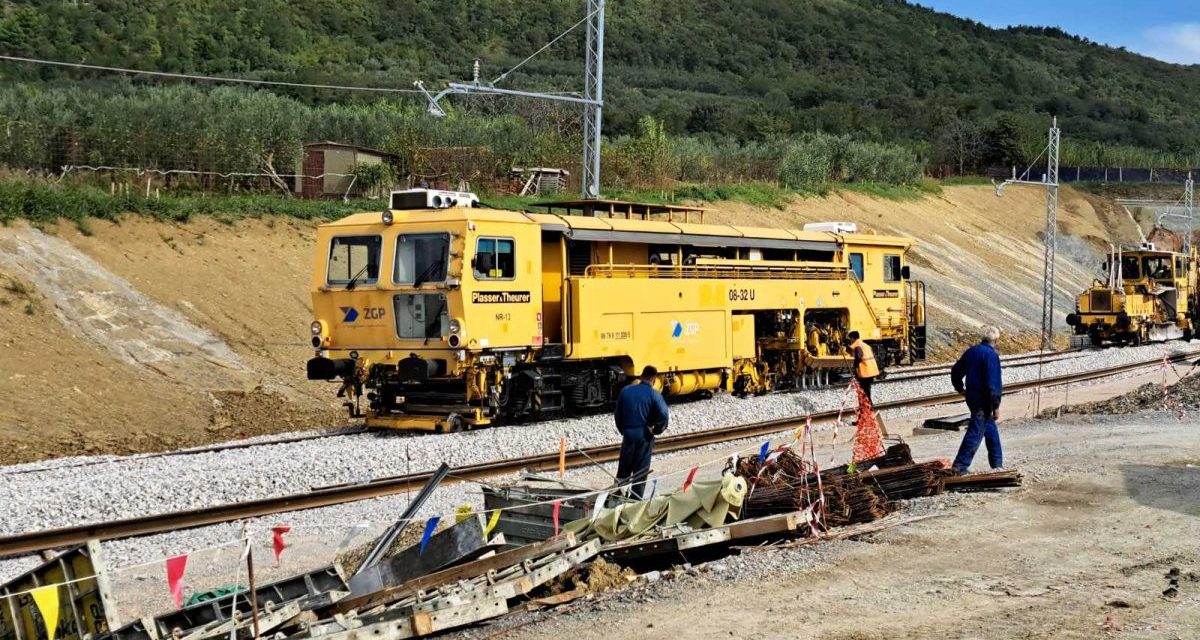
TRIESTE – The new Koper–Divača railway project has reached a key milestone: track laying has been completed along the entire lower part of Section 2. The result comes after the final concrete pour of the supporting slab, which now makes it possible to speed up electrical and mechanical systems installation along the whole stretch.
Section 2 is 11,310 metres long and includes five tunnels, two viaducts and part of the alignment in open cut. Most of it is built with slab track; only the stretch from the last tunnel at Škofije (T8) to the terminus has been built with ballast track. Across the future link as a whole, 61% of the infrastructure has already been laid. In the Lokev tunnel (T1), almost 5 kilometres are complete, while in the Beka tunnel (T2) work is under way on the load distribution slab, a preliminary phase ahead of track laying.
Alongside construction updates, the latest traffic forecasts tied to the new line have also been released. The analysis, prepared for the investment review (NIP-3), is used to estimate revenues, track-access charges and the capacity levels needed to define the project’s economic framework. The projections also include the evolution of the port of Koper’s traffic through to 2060. The study is based on a macro model that takes into account future developments in road and rail networks. Simulations compare two scenarios: with and without the construction of the double track. With the new line in operation, 27.1 million tonnes are forecast to be carried between the port of Koper and Divača in 2060—more than double the 12.5 million tonnes estimated without the investment. The line’s design capacity is 36.9 million tonnes, sufficient to cover demand even beyond 2060.
Without the new alignment, the rail share of freight would fall from the current 55% to 33%, with negative effects on the motorway network and emissions. With the double track, rail traffic would instead retain a share of around 60%. The estimates also point to a sharp increase in volumes at the port of Koper, expected to rise from the current 23 million tonnes to 47 million by 2060.
Energy works serving the new line are also progressing. The Črni Kal traction substation, together with the others planned along the route, will supply 3 kV DC traction power as well as safety and control systems. The facility is being built on a plateau behind the Beka tunnel, at the point where the 110 kV line needed for supply runs. To prepare the connection, new pylons have been installed and then linked via two 110 kV cable lines.