

TRIESTE – The Transport Regulation Authority (ART) has issued a favourable opinion on the investment plan of Autostrade Alto Adriatico, included in the overall financial plan worth €1.895 billion for the concession period through to 2053.
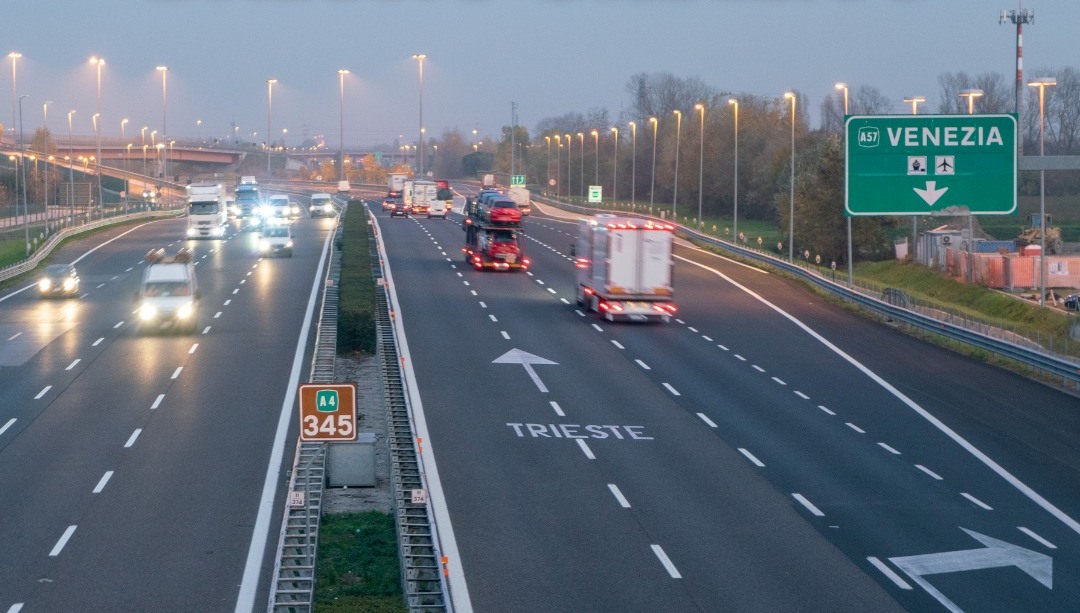
This is a key step for continuing the works, starting with completion of the third lane of the A4 Venice–Trieste motorway. In particular, ART has recognised the additional €600 million needed to cover the increase in construction-material costs, which have risen significantly since the second half of 2021, when the last update of the Cooperation Agreement’s economic and financial plan was signed.
The Authority’s green light reinforces what the concessionaire describes as a record 2025. By year-end, traffic across the entire network is estimated at around 54 million vehicles, up by 2 million compared with 2024 and by more than 20 million compared with 2002. The figure confirms the A4 as a strategic corridor for commercial links between Italy and Central-Eastern Europe, also thanks to the opening of around 40 kilometres of third lane over the past four years.
On the investment side, one of the most significant results is the award of the general contractor tender for completion of the third lane on the 25-kilometre stretch between San Donà di Piave and Portogruaro, for a total value of €870 million. The project goes beyond widening the carriageway and includes rebuilding numerous engineering structures—bridges, viaducts, overpasses and underpasses—with direct impacts on the territories crossed.
Benefits are also reflected in safety. The personal-injury accident rate has more than halved since 2002, falling from 11.4 to 4.9 accidents per 100 million vehicle-kilometres, a figure below the national average. Compared with the previous year, despite higher traffic volumes, the overall number of accidents fell from 610 in 2024 to 524. Alongside major works, routine maintenance continued, with annual investments of around €20 million. Autostrade Alto Adriatico also carried out works on stretches not directly under its responsibility, and developed Italy’s only automatic closure system for the Portogruaro tollgate, while launching a feasibility study for a large photovoltaic park.
The company has also strengthened institutional cooperation, launching agreements with the Eastern Adriatic Sea Port System Authority, Trieste Airport and Fvg Strade, and developing shared information tools with the areas affected by third-lane construction sites.