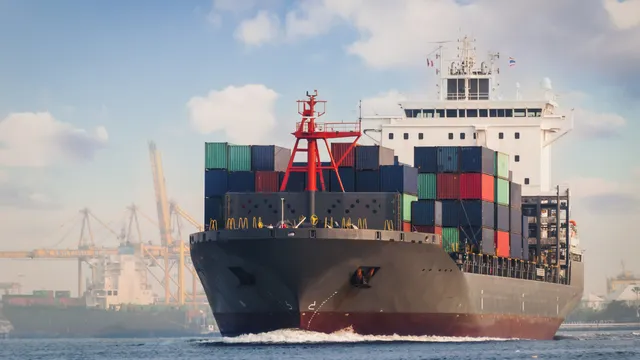


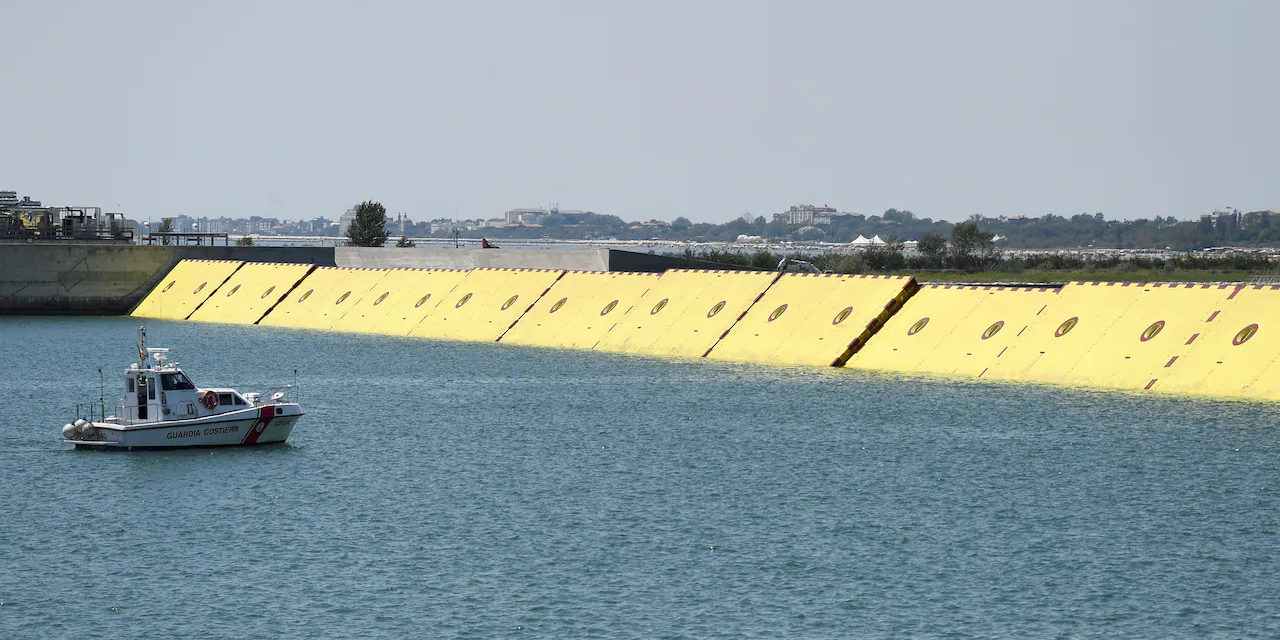
TRIESTE – The MoSE mobile barrier system has been in operation for seven consecutive days to protect Venice from high water, but the daily liftings are causing partial operational difficulties in the port, with impacts estimated by the sector at around €300,000 for each activation.
A truly regulated port, while waiting for the national law to arrive. During the Venice City Council Public Works committee meeting, chaired by councillor Deborah Onisto (Forza Italia), the president of the Lagoon Authority, Roberto Rossetto, outlined the state of progress of the project. The body is not yet fully operational: the liquidation of the Consorzio Venezia Nuova is still ongoing and MoSE’s final testing will require a few more months. A further €100 million of works are also still planned to complete the project. Rossetto said that the annual requirement, between maintenance and liftings, will stand at around €100 million. On the table are the demolition of the Malamocco piarda, completion of the submerged breakwater that will protect the beaches and the lunata in front of the Lido, as well as lagoon maintenance, which includes bricole, rii and cleaning in the inner canals.
On the issue of workers and governance, the unions Cgil, Filctem, Fillea and Fiom have stated that «a clear governance is missing, along with certain funding, the enhancement of skills and political accountability», adding: «We ask the City Council to commit as one in calling on the Government to immediately close this long transitional phase, provide certainty for workers and define a lagoon safeguarding plan with adequate funding».
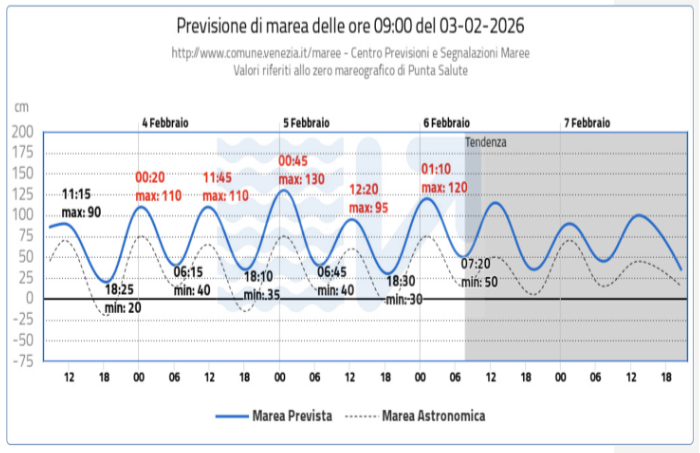
Meanwhile, since MoSE operations began (in July 2020), the system has reached 130 liftings, and it won’t end there. According to forecasts provided by the Tide Forecasting Centre of the Municipality of Venice, the gates will have to keep operating at least until 6 February, given that the expected activation threshold is 110 centimetres and expert assessments believe operations will continue beyond that level, with the last peak, for now, expected at 01:10 on Friday, with 120 centimetres (which, without the protection system, would leave 30% of the city under water).
It is difficult to understand how much each lifting costs, because it depends on a series of factors; what is evident is the damage to the port. According to estimates by sector operators, every time the yellow gates rise, an indirect shortfall for the economic system of around €300,000 is generated. However, it is precisely the forecasting and knowledge system that allows the port to limit the damage, ensuring efficient planning for vessel access to and departure from the port of Venice.