

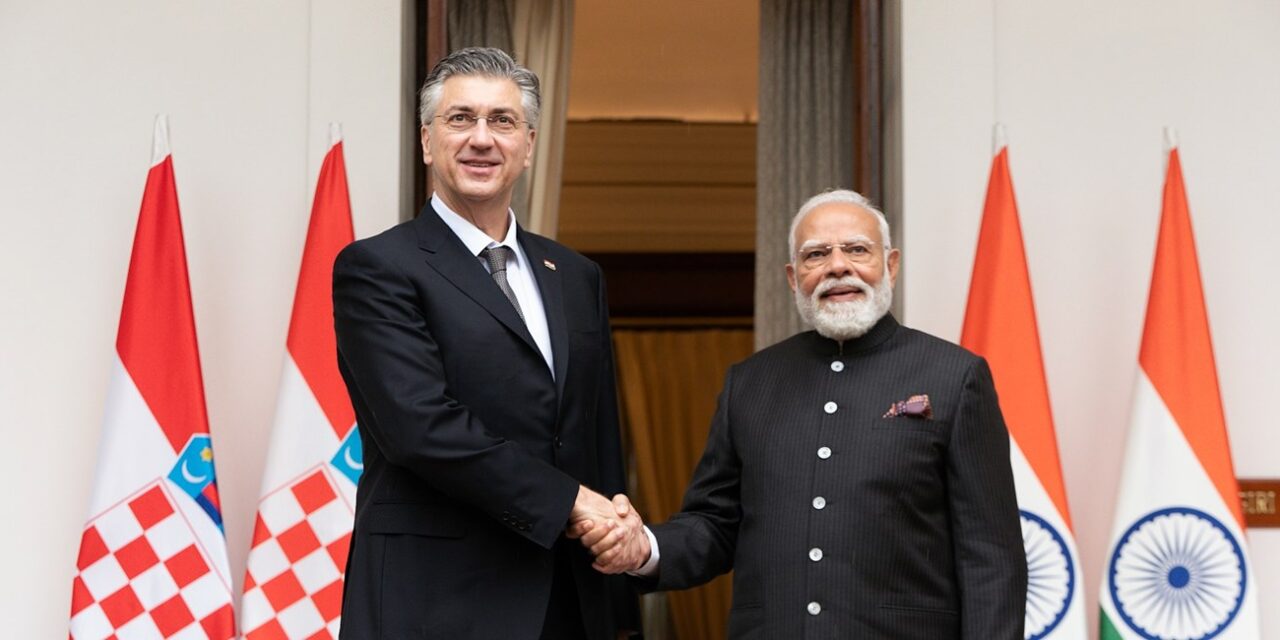
TRIESTE – The official visit to India by Croatian Prime Minister Andrej Plenković has concluded—the first by a head of government from Zagreb to the Asian country. At the core of the mission, alongside political and technological ties, was Croatia’s positioning as a logistics node between the Indo-Pacific and Central Europe, with the Port of Rijeka identified as a key asset.
The visit, from 18 to 21 February 2026, took place at the invitation of Indian Prime Minister Narendra Modi and coincided with the AI Impact Summit in New Delhi. The two leaders discussed economic cooperation, trade, technology and connectivity, also referring to the recent conclusion of the free trade agreement between India and the European Union and urging its rapid implementation.
In his address at the University of Delhi, Plenković devoted significant space to the infrastructure and maritime dimension of bilateral relations. In this framework he explicitly referred to Croatia’s role as a “Mediterranean gateway to Central Europe”, stressing that the Adriatic represents one of the shortest and safest routes between Asia and Europe’s industrial heartland.
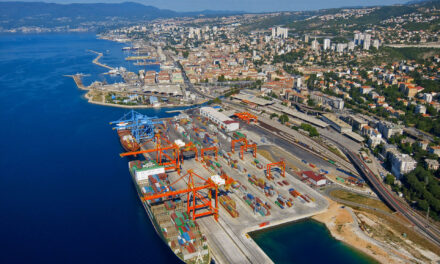
Port of Rijeka
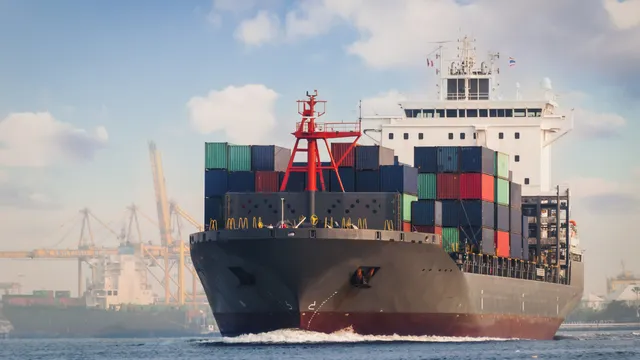
The Port of Rijeka was presented as the pivot of this strategy. According to the Croatian prime minister, the port is undergoing a wide-ranging modernisation and expansion programme with the aim of becoming the leading port in the Upper Adriatic and a preferred entry point for Indian cargo bound for Central Europe.
Strengthening rail connections towards Hungary, Austria and other markets in the Danube area is an integral part of the plan. The idea is to integrate Rijeka along the north–south axis promoted by the Three Seas Initiative, a platform co-founded by Croatia together with Poland that brings together thirteen EU countries between the Baltic, Adriatic and Black Sea.
In his speech, Plenković explicitly linked this infrastructure axis to IMEC, the India–Middle East–Europe Economic Corridor supported by New Delhi. In this vision, Croatia would become the connecting point between the Indo-Mediterranean corridor and the Central-Eastern European backbone, offering an alternative maritime route within the NATO area along the Adriatic.
Economic data provided by the Croatian government indicate that bilateral trade grew by 12% in the first ten months of 2025. Zagreb sees room for expansion in sectors such as pharmaceuticals, digital technologies, renewables and semiconductors, but the logistics component remains central to the strategic narrative.
The India mission follows Modi’s visit to Zagreb in June 2025, also presented as historic. The political message is clear: strengthen the India–EU axis also through physical and port infrastructure. In this framework, Rijeka is not just a national port, but a piece of Europe’s competition to capture flows between Asia and Central European markets.