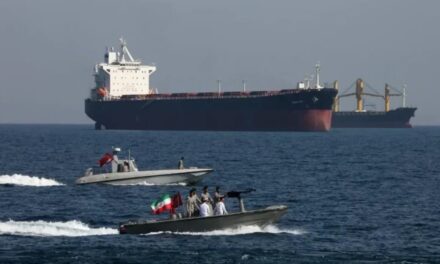


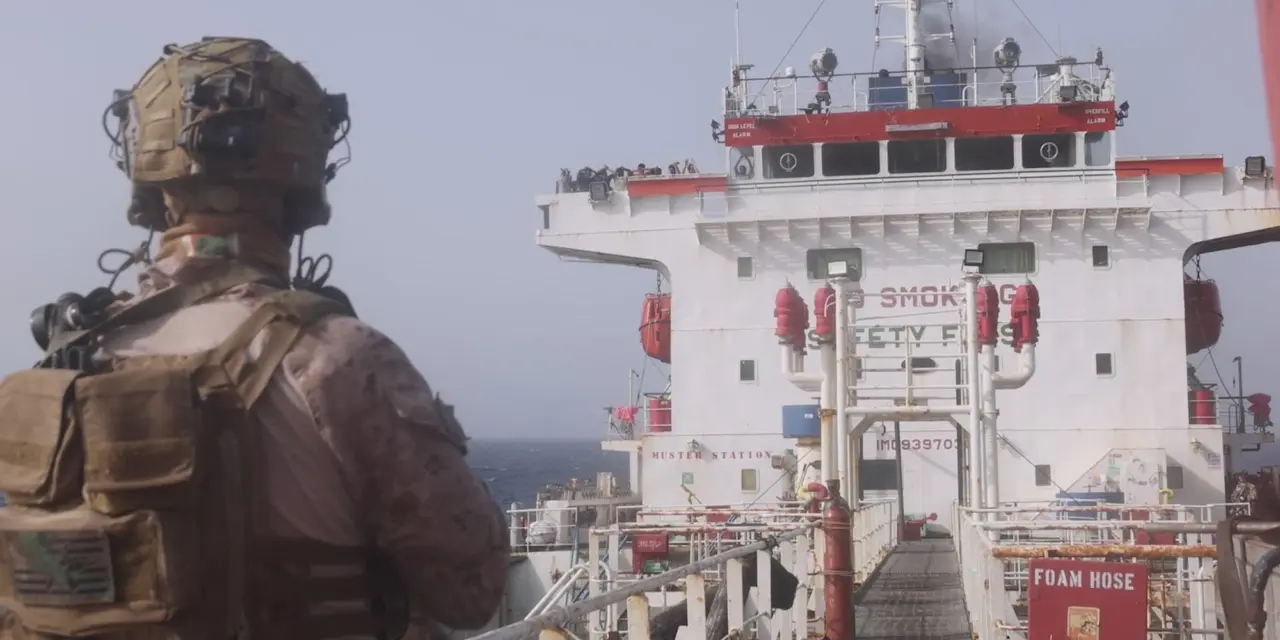
TRIESTE – The reopening of the Strait of Hormuz following the ceasefire agreement between the United States and Iran is gradually bringing one of the world’s most strategic maritime passages back to normal.
The first commercial vessels are returning to transit after months of severe restrictions and security risks.
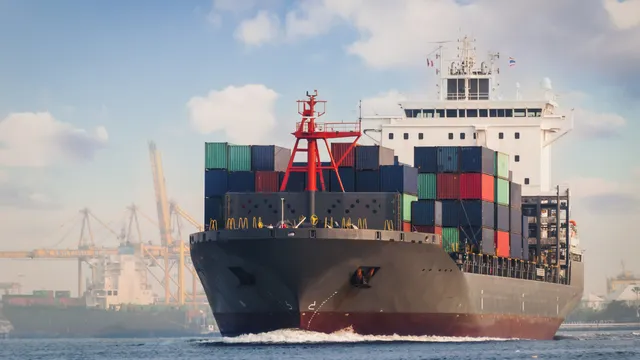
One of the symbols of this restart is the car carrier Grande Torino of the Grimaldi Group, which has left the Persian Gulf after more than 100 days of forced stay in the area. The Italian-flagged vessel, with a crew of 21 seafarers, safely crossed the Strait of Hormuz after receiving authorisation from the Iranian authorities and is now sailing in the Indian Ocean bound for China, where it will be reinserted into services between the Far East and Europe.
The ship was in the Persian Gulf at the end of February for vehicle unloading operations from Asia when the military escalation in the region made it impossible to leave the area. For more than three months it remained at anchor between the coasts of the United Arab Emirates and Iran, in one of the most sensitive areas for world trade. The departure of Grande Torino coincides with the reactivation of energy traffic in the Gulf. According to vessel tracking data, three Saudi supertankers belonging to Bahri, carrying a total of around 6 million barrels of crude oil, crossed Hormuz in the hours following the signing of the agreement between Washington and Tehran. Several other oil tankers and LNG carriers have resumed navigation through the maritime passage, including the LNG carrier Mraikh, controlled by QatarEnergy.
During the conflict, Saudi Arabia had shifted much of its oil exports to the Yanbu terminal on the Red Sea in order to avoid transit through the strait, while numerous Gulf producers had suffered heavy operational restrictions. A sign of normalisation is also coming from Fujairah, in the United Arab Emirates, where several tankers are returning to load crude oil bound for international markets.
Despite the reopening, the maritime sector remains cautious. INTERTANKO, the association representing independent tanker owners, is seeking clarification on mine-clearance operations and route safety, while the London insurance market believes it will take months before logistics chains fully return to normal.
The economic effects of the crisis are also set to continue.
According to Allianz Trade, the normalisation of energy flows will be gradual: around 65% of the lost volumes should be recovered within three months and 80% within four, with a return to full operation only towards the end of the year. The institute forecasts Brent stabilising at around 80 dollars per barrel in the third quarter of 2026, but warns that the inflationary impact of higher energy prices will continue to be felt in the coming months.
For Europe, which is more dependent on energy imports than the United States, the reopening of Hormuz is positive news but not enough to erase the economic effects accumulated during the crisis. Households and businesses will continue to face high costs and weak demand, while central banks will have to manage the difficult balance between inflation and economic growth.