

TRIESTE – Italy confirms its position as the leading cruise destination in the Mediterranean and is looking at further room for growth in the coming years. But at Assarmatori’s Annual Meeting in Rome, the debate focused on the challenges facing European maritime transport between decarbonisation, competitiveness and geopolitical crises.
The country’s leading position in cruises was relaunched by Tourism Minister Gianmarco Mazzi: in a country with a strong island component, the Minister stressed, maritime connections are an essential factor for development and territorial cohesion, while ports are taking on an increasingly strategic role as gateways to the national tourism system.
In the video message sent to the assembly, European Commission Executive Vice-President Raffaele Fitto highlighted the work being carried out in Brussels to identify structural solutions in support of short sea shipping and connections with island regions. Fitto recalled the adoption of the new European maritime industrial strategy and the European port strategy, alongside cohesion policy investments amounting to around €2 billion for seaports and €19 billion for the development of European islands in the 2021-2027 period.
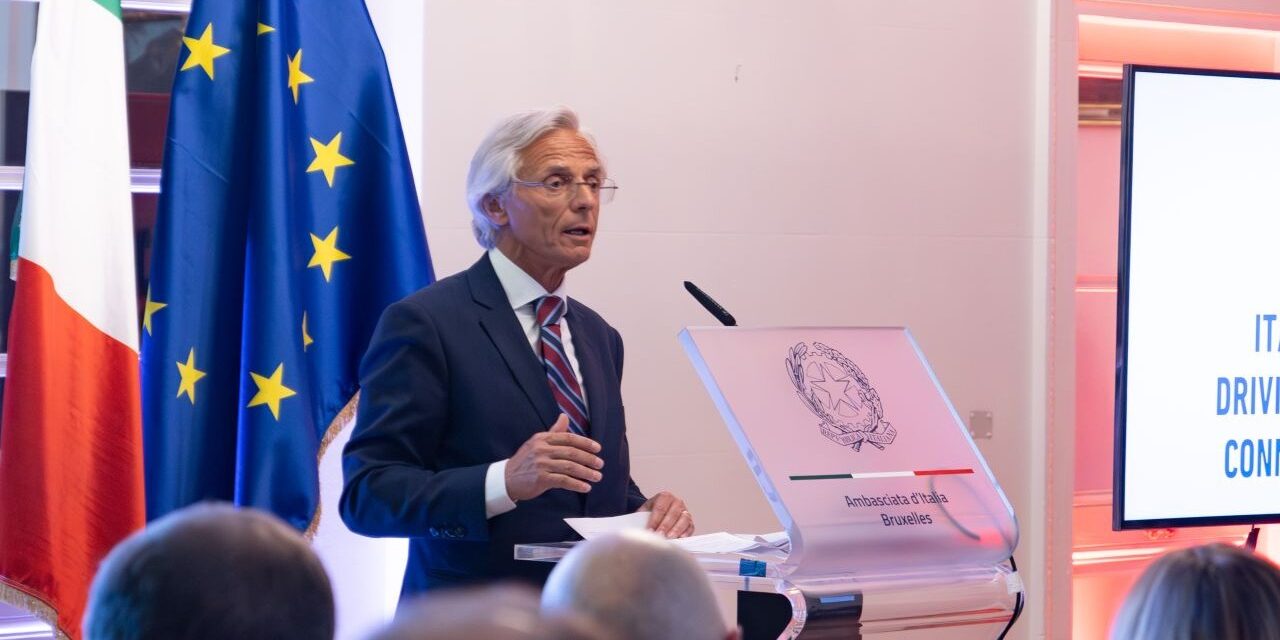
The tone of the speech by Assarmatori president Stefano Messina was much more critical, as he launched a strong attack on European policies for the decarbonisation of maritime transport. According to Messina, the European Union is pursuing an excessively regulatory strategy, unable to take account of the geopolitical context and growing international competition.
The president of the shipowners’ association called for a “courageous” revision of the ETS system (Emission Trading System, the European CO₂ emissions trading scheme), the European emissions market that also involves maritime transport. In particular, Assarmatori is calling for the exclusion of connections with islands, the protection of the Motorways of the Sea and specific measures for the container transhipment sector, considered the segments most exposed to the effects of the regulation.
Messina also criticised the fact that the resources generated by the ETS are not fully reinvested in the maritime sector to support the energy transition, fleet renewal and the investments needed for decarbonisation. According to Assarmatori, the proceeds of environmental taxation should be allocated as a priority to the sector that generates them, as provided for by the European directive itself.
Among the most innovative issues addressed during the assembly was naval nuclear propulsion. At a time when the Italian Parliament is discussing the enabling law on nuclear power, Messina indicated fourth-generation reactors and Small Modular Reactors (SMRs) as a concrete prospect for drastically reducing emissions from maritime transport.
According to the president of Assarmatori, several international pilot projects are already demonstrating the technical feasibility of these solutions. In addition to the environmental benefits, nuclear power would make it possible to overcome one of the main obstacles to the spread of alternative fuels, eliminating the need to develop complex logistics networks and dedicated infrastructure for the supply of sustainable fuels in ports around the world.
Maritime labour was also at the centre of the debate. Messina called for the restoration of social security contribution relief for seafarers employed on short sea routes, stressing that labour costs represent one of the main expenditure items for shipowners and directly affect the competitiveness of Italian companies. The measure would mainly concern services that are essential for territorial continuity and for the mobility of island communities.
On the international front, the president of Assarmatori welcomed the announcement of an agreement between the United States and Iran, but urged caution regarding the situation in the Strait of Hormuz. According to Messina, maritime traffic may gradually return to normal, but several days will be needed to verify the solidity of the agreements and several months to fully restabilise commercial flows. He expressed clear opposition to any hypothesis of a toll for crossing the strait, considering it incompatible with the principle of freedom of navigation.
Assarmatori’s assembly was attended by more than 700 representatives of the maritime and port cluster, the business community and institutions. Speakers included Minister of Enterprises and Made in Italy Adolfo Urso, Minister of Education and Merit Giuseppe Valditara, Deputy Minister of Infrastructure and Transport Edoardo Rixi, Chief of Staff of the Italian Navy Giuseppe Berutti Bergotto and Assoporti president Roberto Petri. The protagonists of the round table dedicated to the shipowning sector also included Mariaceleste Lauro, Achille Onorato and Vincenzo Romeo.