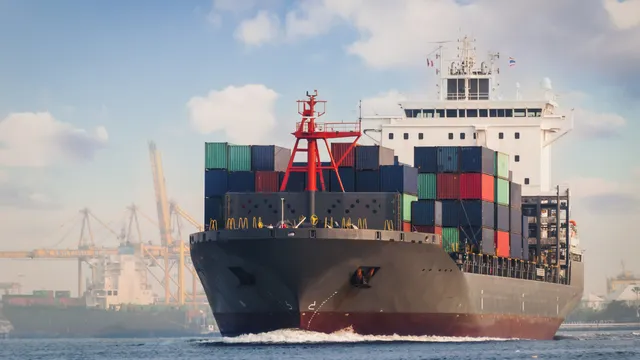


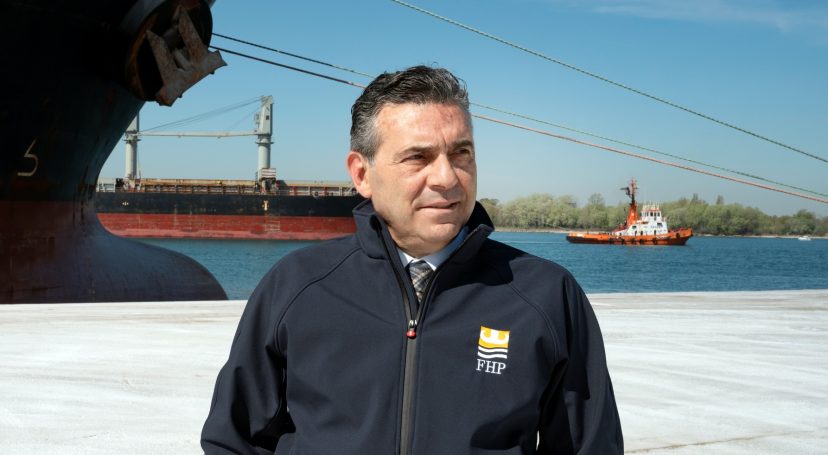
TRIESTE – Cargo volumes are growing, but quays are approaching full capacity; deeper draughts and expanded rail services are urgently needed. Gian Carlo Russo, CEO of FHP Group in Monfalcone, outlines the current state of the port – managed by the Eastern Adriatic Sea Port Authority – and predicts a doubling of traffic volumes if planned interventions are carried out.
In recent years, traffic at the terminal has increased. Which cargo segments are driving this growth?
“Certainly steel imports for the region’s heavy industry, as well as project cargo and forest products.”
Where do you still see room for development in Monfalcone?
“Today the port is quite saturated, both in terms of storage areas and quay length. After the outbreak of the conflict in Ukraine, the primary source of supply for heavy industry shifted to the Far East. Since these routes are much longer, the ships deployed are significantly larger, both in tonnage and length, compared to those arriving from Mariupol. As a result, berth times are longer due to deeper holds and larger volumes, and the quay can accommodate fewer vessels simultaneously due to the increased ship length.”
What measures are being taken to address the situation?
“During peak periods, the anchorage area becomes very crowded. To cope with demand, we’ve introduced three-shift operations – unlike in the past – to free up berths faster and avoid costly waiting times for ships. To meet the market’s demands for port development, it is crucial to implement the Port Regulatory Plan, which calls for a longer quay and expanded storage areas with layouts tailored to specific cargo types. Furthermore, improving rail services – both in terms of infrastructure and shunting operations, including night shifts – is essential. In the first half of this year, over 55% of cargo handled at Monfalcone moved by rail, albeit with some operational challenges. Rail transport makes the port’s hinterland more sustainable from both environmental and safety perspectives, and this is where future efforts must focus.”
Are seabed depths still a constraint for certain types of traffic?
“Deeper draughts would eliminate the need for lightening operations in Koper before completing the call at Monfalcone, which currently has a depth of -10.90 metres.”
What are the risks if these interventions are delayed further?
“Monfalcone has become attractive not only for the local area but also for Austria and countries to the east along Corridor V. However, this cargo moves mostly – if not entirely – by rail. As mentioned, intermodal rail capacity is struggling to meet demand. Without improvement, there is a risk of traffic being diverted elsewhere, resulting in reduced social and industrial development.”
What are the immediate priorities?
“Ensuring 24/7 operations, or at least full three-shift coverage, across all port services: terminal operators, trains/shunting, tugboats, nautical technical services, customs gate operations, workforce training, and streamlining of underground infrastructure.”
How do you view the collaboration with institutions in solving infrastructure bottlenecks?
“It’s essential. Dialogue with institutions is positive, and fortunately, there is a high level of attention on both the port and the wider port system.”
Where do you see the terminal in five years if the planned works are completed?
“We could see cargo volumes double. Today, Monfalcone handles around four million tonnes, but with a longer quay, deeper draughts, larger yards, and efficient rail intermodality, it could become a key reference point not only for northeastern Italy, but also for neighbouring eastern countries and Bavaria.”