

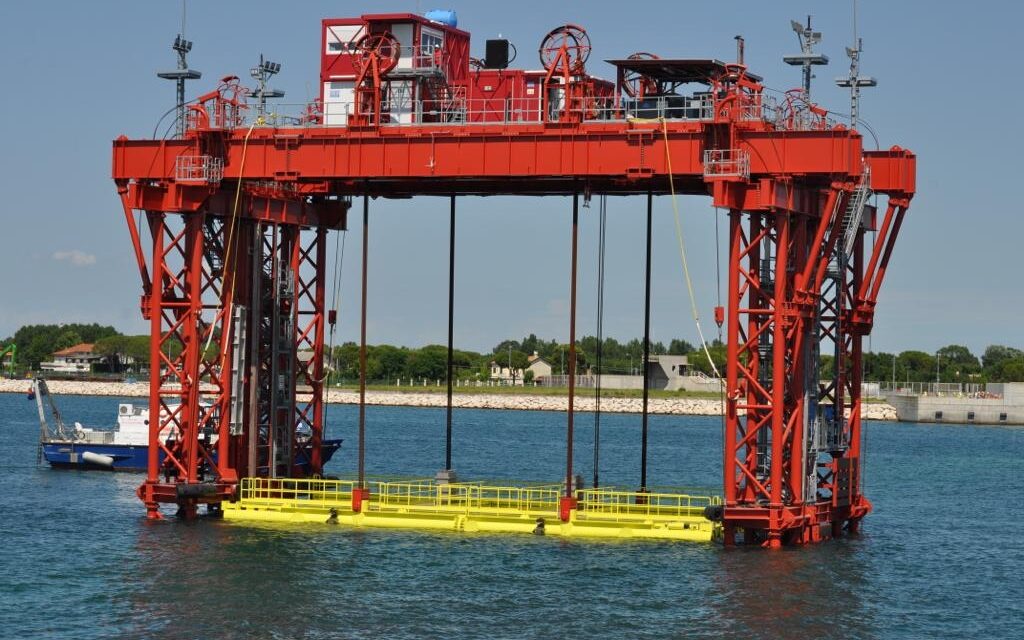
TRIESTE – The €330 million needed to guarantee continuity of Mose activities has arrived: the decree adopted by the Ministry of Infrastructure and Transport, in agreement with the Ministry of Economy and Finance, unlocks the resources required for completion of the works, maintenance of the system of barriers and continuation of the agreement with Consorzio Venezia Nuova during the transition phase towards full operation of the Lagoon Authority.
The measure prevents the interruption of Mose lifting, management and maintenance activities and makes it possible to settle payments to companies, which had so far remained blocked. In this transitional phase, the Public Works Department will authorise payments, coordinating activities with the Lagoon Authority, which from 1 July will take on 25 employees from the same Department.
Venice mayor Simone Venturini described the decree as «an important, awaited and not inevitable result», stressing that the measure guarantees technical and administrative continuity for an infrastructure that is fundamental to safeguarding the city and the lagoon. The president of the Lagoon Authority, Roberto Rossetto, highlighted that the conditions now exist to continue safeguarding works without interruption, while the extraordinary commissioner of Consorzio Venezia Nuova, Massimo Miani, explained that the decree will make it possible to complete the works still under way and ensure continuity for the Consortium’s activities and the workers involved on the construction sites.
The unlocking of the resources, however, has not ended the controversy. The unions are in fact contesting the fact that, during the transitional phase, the Public Works Department is returning to play a central role in managing the resources, while the Lagoon Authority had been established precisely to centralise responsibilities for Mose and the safeguarding of the lagoon. The issue also remains open of the future of workers at Thetis, Consorzio Venezia Nuova and Comar, who are set to move into the future in-house company of the Authority.
Davide Calderan, president of the Venice Port Community, also intervened in the debate, shifting attention to another issue.
«These days there is discussion about funds from Rome for Mose maintenance. For the Venice Port Community, this is an astonishing debate, one that should not exist. These are resources that should be taken for granted, guaranteed, because after everything that has been done to bring Mose into operation, a complex system of works that saves Venice, if the funding of such a project is really being questioned, then something is wrong. We have an Italian engineering achievement recognised around the world; it must be able to operate without disruption, guaranteeing activation at the established threshold, namely 110 centimetres in Venice».
According to Calderan, the priority should be another: «If anything, real safeguarding of the entire city should be made possible, securing once and for all the funds needed to bring the city to a 110-centimetre threshold, from the area around St Mark’s to Rialto, through the various districts. That is the real issue to be resolved; on the rest, there should not even be a debate. Once Venice is safe, Mose will then be able to operate properly, allowing both the city and economic operators a prosperous future».