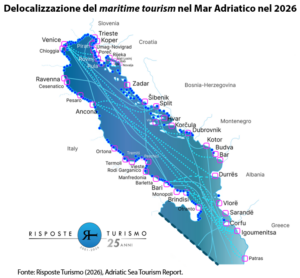


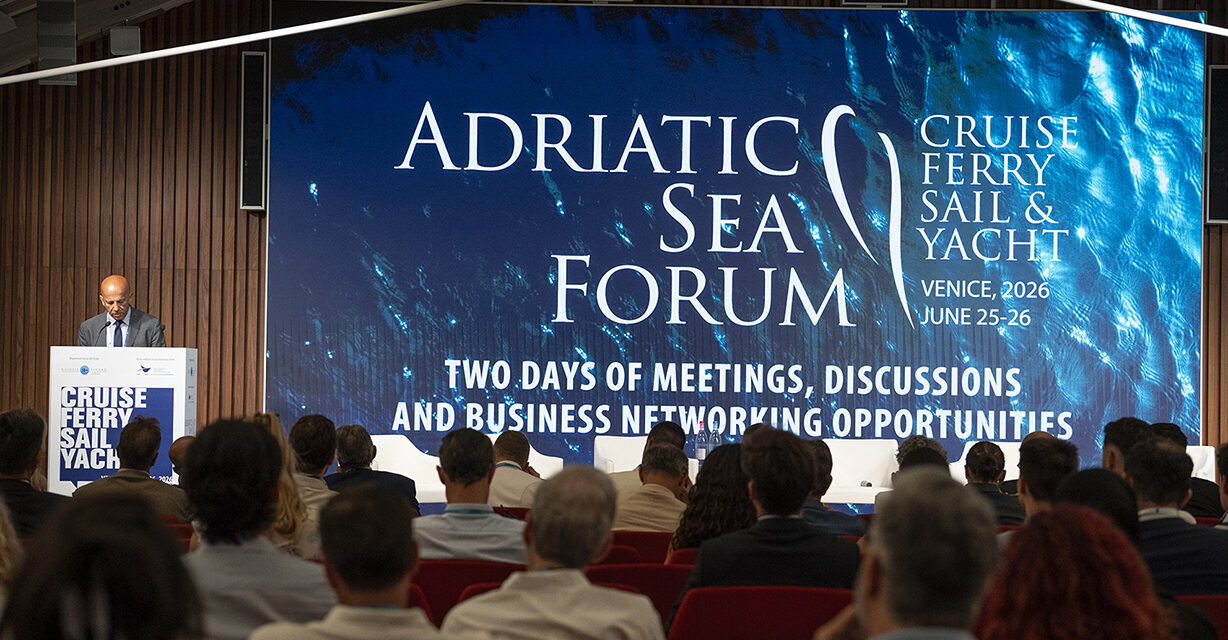
TRIESTE – Sea tourism continues to show growth dynamics in the Adriatic. According to the new edition of the Adriatic Sea Tourism Report produced by Risposte Turismo, the research and consulting company specialised in the tourism macro-industry, forecasts for 2026 indicate increases across all segments: cruises, ferries and boating.
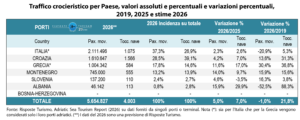
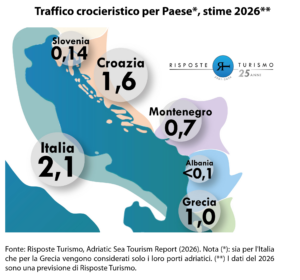
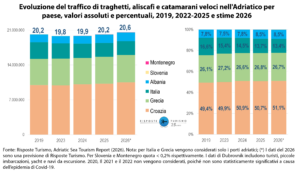
In the cruise sector, 5.7 million passengers handled are expected (+6% compared with 2025), with around 4,000 ship calls (+7.7%). The figures, while positive, remain below the pre-pandemic record of 2019. Ferries, hydrofoils and catamarans, vessels combining speed and capacity, are expected to handle 20.6 million passengers, with modest growth of 2.1% compared with 2025.
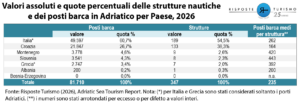
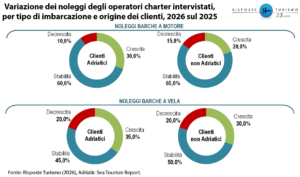
In the boating segment, yacht charter in the sail and motor sectors is gaining new momentum, driven by local demand. The total number of berths available in the Adriatic exceeds 81,000 (+1.3% on 2024), consolidating the offer for this type of tourist.
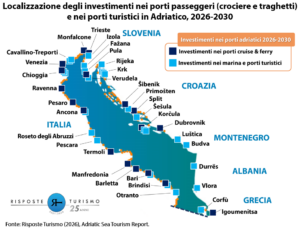
The map of infrastructure investments is particularly substantial. More than €843 million dedicated to sea tourism is planned for the four-year period 2027-2030, concentrated on passenger ports, nautical facilities and combined terminals. The funding concerns all seven countries bordering the Adriatic: Albania, Bosnia and Herzegovina, Croatia, Greece, Italy, Montenegro and Slovenia, distributed across 25 regions and more than 150 destinations.
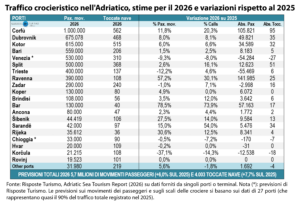
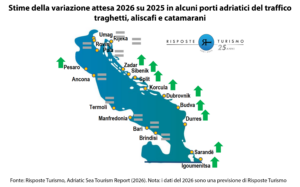
The geography of demand continues to favour Croatian and Greek ports. In 2025, cruise traffic saw Corfu, Greece, dominate with 1 million passengers, followed by Dubrovnik, Croatia, with 675,000 and Kotor, Montenegro, with 615,000. Trieste, the leading Italian Adriatic port, handled 400,000 cruise passengers, with limited growth forecast for 2026 (+4.6%).
Some destinations report more marked performances. Bar, Montenegro, recorded the sharpest change (+78.5%), while Ravenna (+57.2%) and Sarandë, Albania, (+15%) demonstrate the vitality of niche segments. Split, Croatia, maintains solid dynamics (+2.6%), while Venice recorded an annual contraction (-9.3% in 2025), a figure still affected by cyclical and regulatory factors.
The composition of traffic by country shows Italy accounting for 37.3% of total passenger movements, Croatia for 28.5%, Greece for 17.8%, Montenegro for 13.2%, Slovenia for 2.4% and Albania for 0.8%. The picture highlights concentration in the central countries of the area, but also signs of diversification towards emerging destinations. Francesco di Cesare, president of Risposte Turismo, stressed that the report confirms the potential of a sector that continues to represent an opportunity for economic development for the entire Adriatic region, provided that the planned infrastructure investments translate into operational projects within the expected timeframe.