

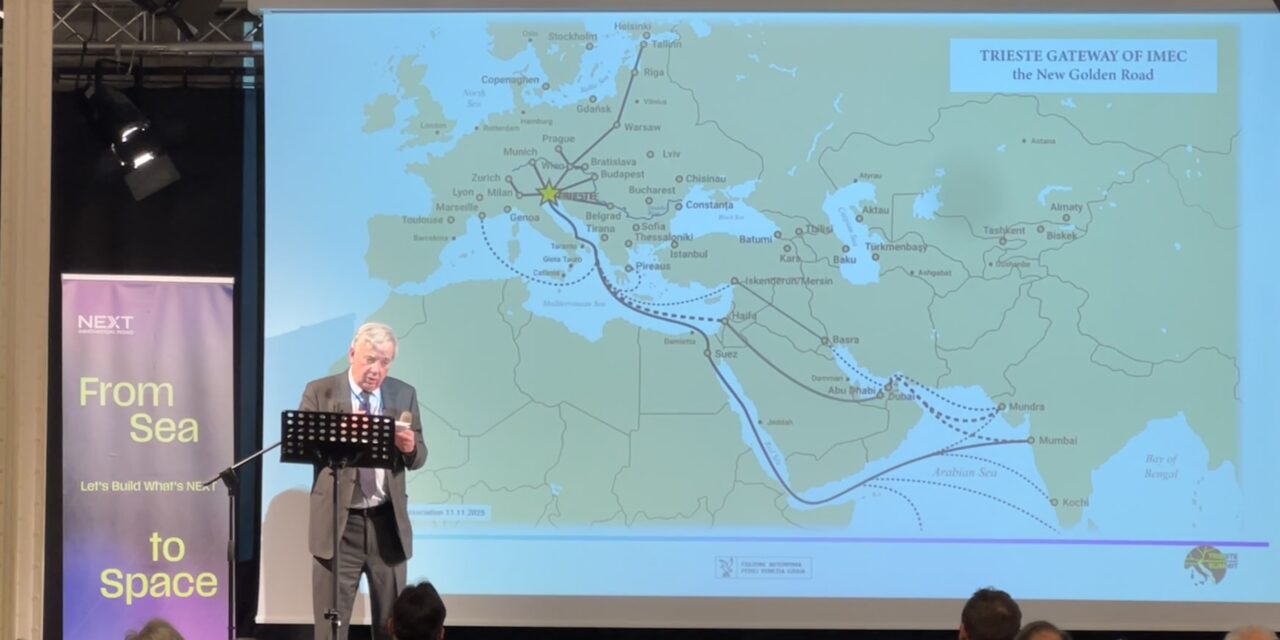
TRIESTE – Trieste is positioning itself as the main European gateway of the India–Middle East–Europe corridor. At the Next Innovation Road 2026 forum, promoted by the MARE FVG cluster, the port of Friuli Venezia Giulia was presented as a reference platform to capture new trade flows and strengthen connections with Central and Eastern Europe.
The event took place today at Magazzino 26 in Porto Vecchio. The “Digitalization between Sea and Space” forum was conceived by the M.A.R.E. TC FVG cluster to foster collaboration among companies, research centres and regional stakeholders on digitalisation and new technology value chains between sea and space. Participants included Fincantieri, Leonardo, Area Science Park and the University of Trieste.
In the session dedicated to Indo-Mediterranean corridors, Francesco Parisi, president of the namesake shipping and forwarding company and of the Trieste Summit Association, pointed to the port’s growth figures. Between 2007 and 2023, traffic at the Port of Trieste increased by 220%, a figure that rises to 235% when considering the wider system including Koper and Rijeka. This trend, he said, is more than ten times the average recorded by some major European ports over the same period.
According to Parisi, this development has consolidated Trieste as an intermodal platform towards Central and Eastern Europe, with a hinterland of more than 110 million people across eleven countries connected by rail. The reference is to an already operational network integrating sea and rail, which could be further strengthened through new corridors.
Within this context sits the India–Middle East–Europe Corridor (IMEC) project. Tensions in the Red Sea and criticalities along the Suez Canal, Parisi observed, have highlighted the vulnerability of some established routes. The corridor linking India, Gulf countries and Europe would therefore represent a structural response, able to complement traditional maritime routes and enhance overland connections. Not only goods, but also data and energy form part of the vision of an integrated network that identifies the Port of Trieste as Europe’s main access point. The interest concerns high-growth markets and potential developments towards other countries in West Asia.
The role of the Region was also central to the discussion. Regional councillor Alessia Rosolen pointed to the goal of moving beyond a purely logistics-crossroads role to position Friuli Venezia Giulia as a strategic platform integrating sea, space, innovation and energy.
Rosolen recalled regional support for the creation of a multi-sector cluster in high-potential fields such as aerospace, underwater technologies and renewable energy—areas that have taken on growing relevance not only industrially but also geopolitically. She highlighted the evolution of MARE FVG, which began with the involvement of major industrial players and then expanded to other local actors, as a step towards a broader platform capable of connecting businesses, universities, research centres and investors.
In her remarks, she stressed that digitalisation is a cross-cutting process affecting all productive sectors and requiring real integration between research, industrial application and the market. The ability to combine innovation with industrial development, she said, directly influences a region’s trajectory and the building of European strategic autonomy through regional ecosystems capable of working as networks. The Region’s commitment, she concluded, will be to ensure resources and support, aiming to turn dialogue and technology transfer into concrete market results and new skilled employment.