

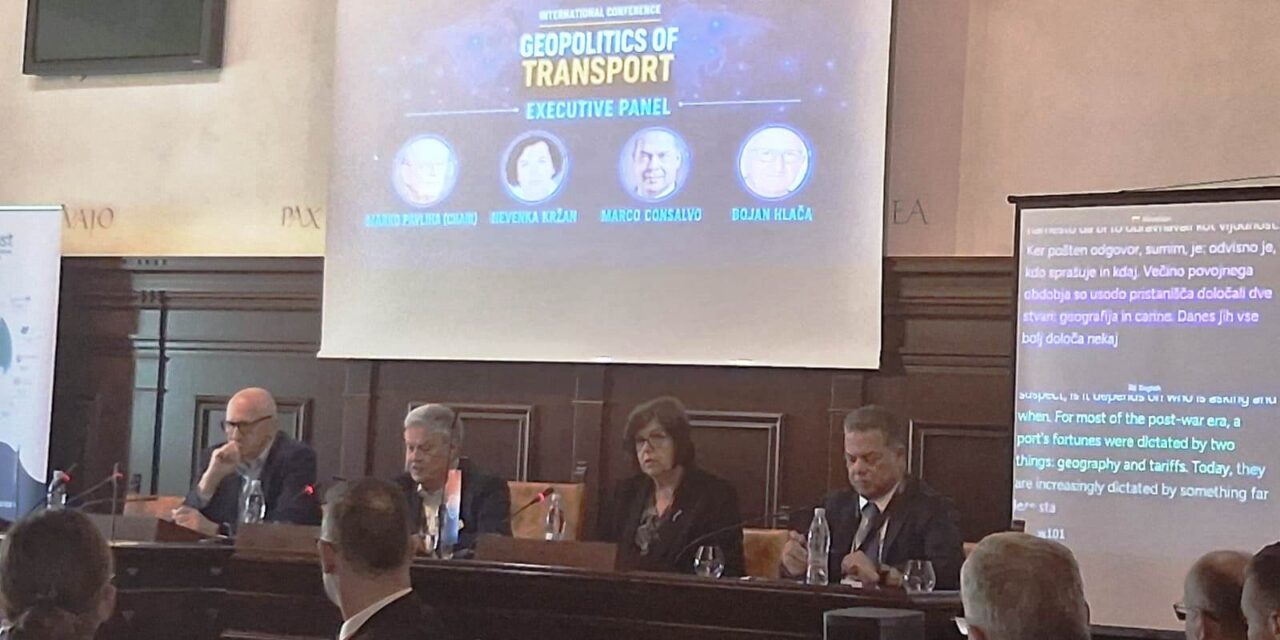
KOPER – The ports of Trieste, Koper and Rijeka are once again talking about collaboration and cooperation for development: competition between the ports is not being called into question, and each will seek to do its utmost for growth.
But they will work together as a system on routes, logistics corridors and rail networks in order to attract new traffic for the benefit of all. This was the clear direction that emerged this morning, Monday 8 June, in Koper at the International Conference on the Geopolitics of Transport organised by the Slovenian university EMUNI together with the Bled Strategic Forum.
For the first time, the event brought together the presidents of the port authorities of Trieste, Marco Consalvo, and Rijeka, Bojan Hlača, as well as the head of the company managing the port of Koper, Luka Koper, Nevenka Kržan, before an audience of leading logistics and maritime law experts from Slovenia, Italy and Croatia.
The first political input, however, came from the new Slovenian Minister of Foreign and European Affairs, Tomaž Kajzer, a long-serving diplomat, who stressed the need for «stronger cooperation between the ports, first of all with Trieste, but also with Rijeka, and for joint work on transport routes and corridors, as a factor of resilience in the face of geopolitical shocks».
This political line was then also shared by Slovenian MEPs Vladimir Prebilič, Matjaž Nemec and Tamara Kozlovíč, who underlined the importance of «cooperation between ports» because «together, Trieste, Koper and Rijeka play a fundamental role in the resilience of the transport network. We must all row in the same direction». Mario Draghi’s recommendation was also recalled: in his development document, he speaks of a «strategic vision for the development of European transport, the backbone of EU competitiveness».
The objective for the ports of Koper, Trieste and Rijeka is to attract new traffic routes for the benefit of all. This was confirmed first by Luka Koper president Kržan, who explained how the port has «changed its way of working» in order to face traffic volatility, the storms of geopolitical and tariff tensions and the imbalances caused by changing markets. «Not only competition: we must cooperate and work together as a system of ports, the single maritime gateway from Asia to Central and Eastern Europe», the president insisted, announcing a study that will be presented in Brussels. A genuine “cluster” of ports with strengths capable of providing an alternative to Northern European ports and offering greater potential.
It is also for this reason that the port of Rijeka is equipping itself with new terminals and infrastructure, president Hlača explained. «In the long term, competition will no longer be between us, but with the Northern ports. With Koper and Trieste we must act as a system and cooperate more and more».
This new policy of cohesion between the ports was endorsed by the president of the Trieste and Monfalcone Port Authority, Consalvo: «Cooperation between the three ports is needed; it is essential, even though in Italy there are different regulatory systems. But there is the same target market for everyone: Central and Eastern Europe». Consalvo also spoke about the strengths of the port, Italy’s leading railway port and a Mediterranean energy terminal through its oil pipeline to Germany, Austria and Czechia. «We must accelerate integrated connectivity with those Central and Eastern European markets».
The Koper forum offered an in-depth look at Adriatic logistics and included among its Italian guests leading experts, from maritime law scholars at the University of Udine such as Alfredo Antonini and Claudio Cressati, to professor Maurizio Maresca, president of Alpe Adria, his son Davide Maresca, professor in Genoa, and Paolo Costa of the University of Venice.