

TRIESTE – In Trieste, the need has emerged to strengthen infrastructure and interoperability in order to support traffic between the Upper Adriatic and the Balkans, but also to keep ports competitive as hubs for central and eastern Europe.
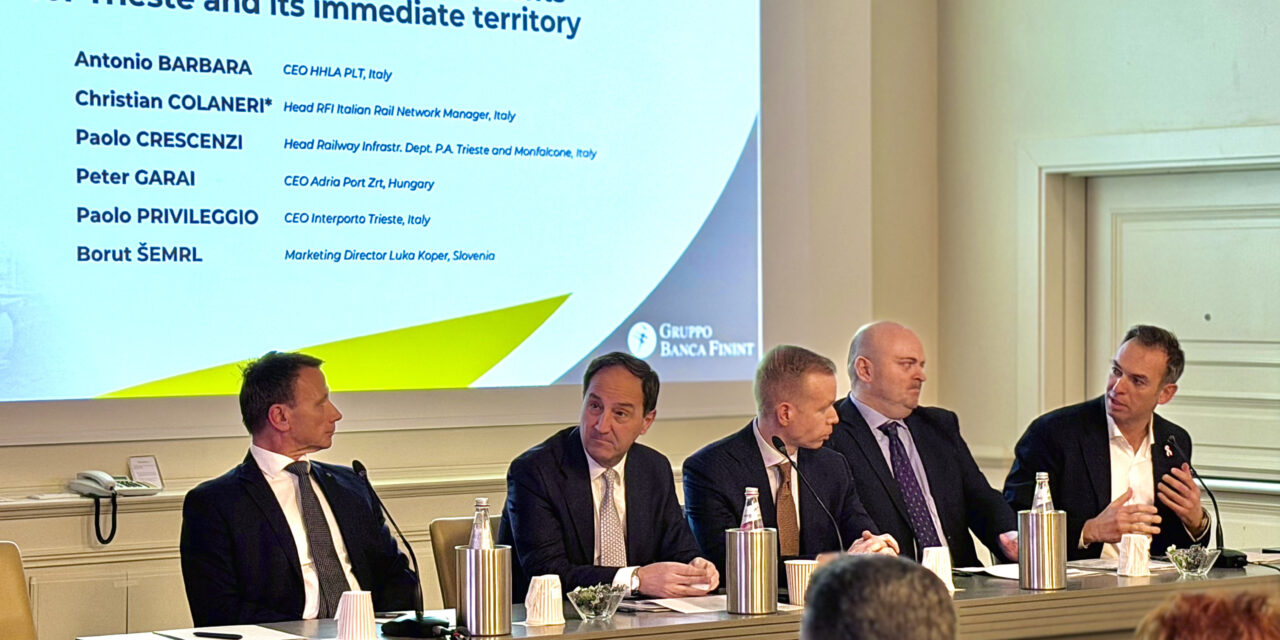
The conference on “Priority Actions: Upper Adriatic Interoperability & Balkan connectivity” confirmed a clear line: traffic growth depends on infrastructure capacity, especially rail, and on greater integration between national systems.
The debate recalled the role of European initiatives, starting with the Global Gateway, while also stressing the need to match strategies with concrete funding tools. At the same time, the agreement between India and the European Union and new corridors such as IMEC (the India-Middle East-Europe Corridor) are set to reinforce the centrality of the Adriatic and, in particular, the port of Trieste as a connection point between markets.
Several speakers highlighted the need to strengthen Friuli Venezia Giulia’s rail system, which is well developed but could become a constraint on traffic growth over the next decade. The port of Trieste in particular, if it is to grow, needs a stronger and higher-capacity rail network. Development prospects point to a significant expansion of rail infrastructure serving the port, with the goal of reaching around 30 tracks and 12 connected terminals over the next ten years. But the central issue is not only the expansion of port facilities: what is needed is the creation of real logistics corridors, capable of ensuring continuity and capacity along the entire chain.
On the Slovenian side, reference was made to the major modernisation plan for the rail network, with investments under way above all on inland links. The final impact is not yet fully defined, but the aim is to increase the overall capacity of the system and support traffic growth. In the second panel, operators and companies focused on another key issue: interoperability. The digitalisation of processes and compatibility between national systems – electrification, signalling and technical standards – are necessary conditions to make international rail traffic flow smoothly between countries. Without this step, even new infrastructure risks failing to express its full potential.
It was also pointed out that, once the works are completed, the market will be able to offer customers a wider choice among Upper Adriatic ports such as Koper, Rijeka and Trieste. But to reach that result, greater coordination between countries and more efficient use of existing capacity, which is currently partly underused, are needed. A shared message concerned timing: completion of major works cannot be awaited. Interoperability, organisation and digitalisation must start now. «Infrastructure is needed, but not only to serve the individual port. The point is to build infrastructure capable of connecting the ports and logistics of the Upper Adriatic», said Stefano Visintin, president of Confetra Fvg and among the organisers of the conference as a member of Trieste Summit.
The focus dedicated to the port of Trieste also clearly brought out the issue of rail capacity. The Upper Adriatic system captures traffic linked to economies that account for around 44% of world GDP. However, without an adequate rail network, these flows risk shifting to other routes. The logic is simple: if the corridor lacks capacity, cargo will find other ways. «Trieste already has high rail capacity compared with other Italian ports, but it remains a terminal station and suffers from a lack of redundancy. This means maintenance works can have a significant impact on operational continuity» explained Antonio Barbara, CEO of HHLA Plt Italy.