

TRIESTE – Solid and liquid bulk cargo traffic continues to support the northern Adriatic ports, while the Suez Canal crisis and the reshaping of international shipping routes are mainly penalising Trieste’s container segment.
This is what emerges from the “Port Infographics 2026” report produced by SRM and Assoporti using 2025 data.
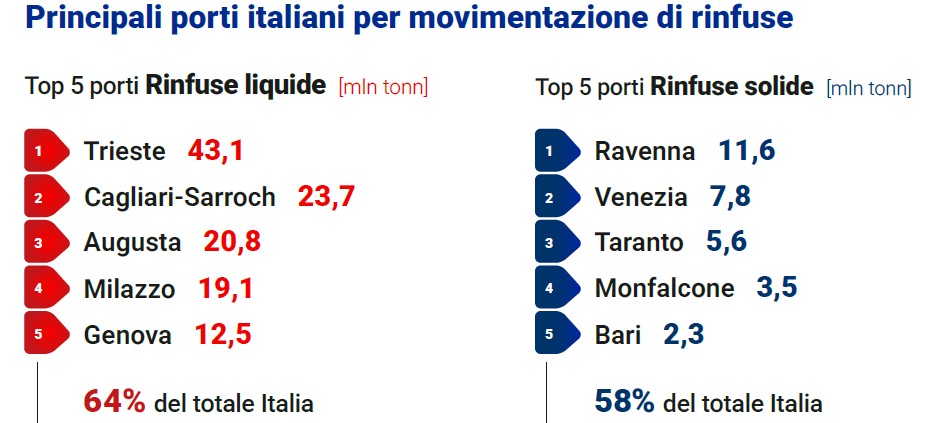
The document highlights that Trieste remains Italy’s leading port for liquid bulk cargo handling, thanks to the SIOT crude oil terminal, with 43.1 million tonnes in 2025 (+4.4%). The Friuli Venezia Giulia port also confirms its position among Europe’s leading ports in the sector, ranking fourth in the EU liquid bulk cargo table for the first nine months of 2025, with 31.6 million tonnes.
Overall, including the port of Monfalcone, the Eastern Adriatic Sea system handled 64.3 million tonnes (+1.8%). Ro-Ro traffic increased to 9.67 million tonnes (+10.4%), while the container segment declined: 6.93 million tonnes (-22.6%) and around 682,000 TEUs (-19%).
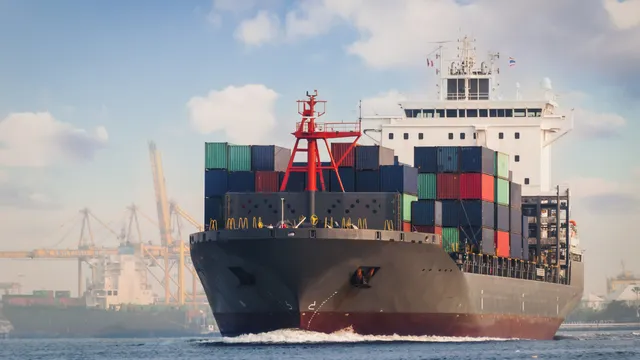
The report indirectly links these trends to the international situation. SRM notes that in 2025 transits through the Suez Canal were still 48% lower than in 2022, with many shipping companies continuing to use the Cape of Good Hope route.
By contrast, Monfalcone performed very positively, exceeding 4.28 million tonnes overall in 2025 (+19.4%). Growth was driven mainly by solid bulk cargo, which rose to 3.49 million tonnes (+21.9%). Monfalcone thus entered the top five Italian ports in the sector, together with Ravenna, Venice, Taranto and Bari.
Venice also confirmed a positive trend. The Northern Adriatic Sea system closed 2025 with 26.2 million tonnes (+5.1%). Venice confirmed its position as Italy’s second port for solid bulk cargo, with 7.78 million tonnes (+7%), and recorded a strong increase in container traffic, with 532,000 TEUs handled (+11.3%).
The report also highlights Venice’s strong cruise performance: 584,000 cruise passengers in 2025 (+6.7%).
Among the most significant figures is Ravenna, which confirmed its position as Italy’s leading port for solid bulk cargo, with 11.56 million tonnes (+9%). The Romagna port also grew in overall traffic, reaching 28 million tonnes (+9.6%), one of the highest increases among Italy’s main ports.
Overall, the dossier shows that ports more closely linked to industrial, energy and raw-material traffic are going through a more stable phase than ports more exposed to major Asia-Europe container flows, which are still affected by the geopolitical crisis and the diversion of global shipping routes.