

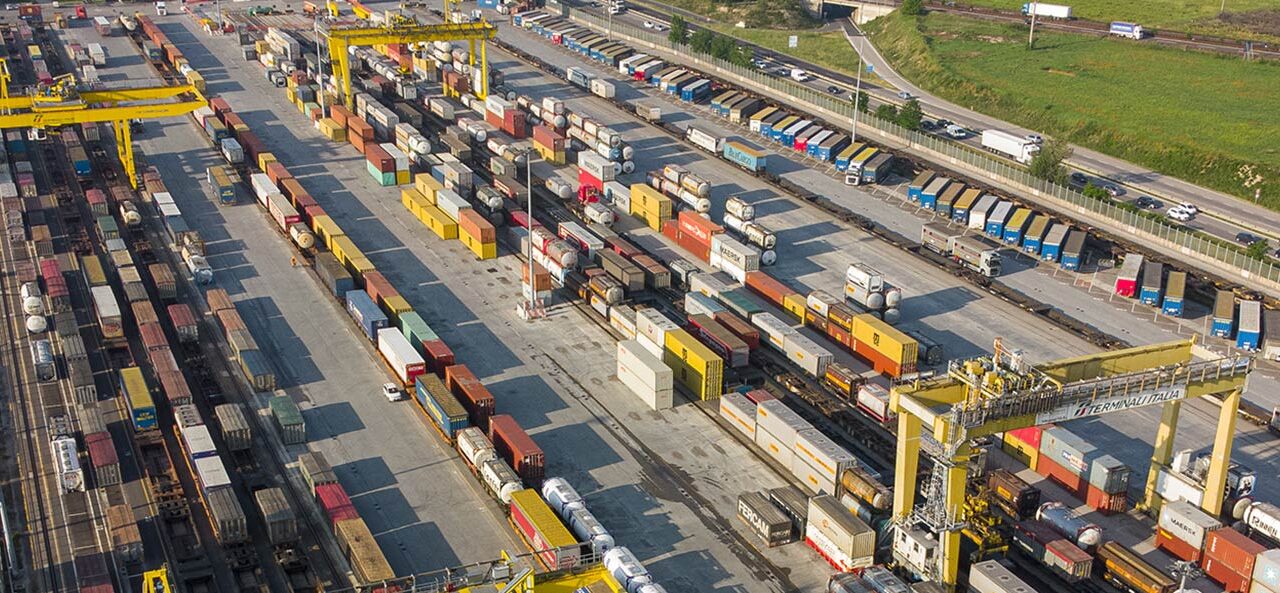
TRIESTE – Rail freight transport continues to lose volumes in Italy, closing 2025 with another negative result. According to the 2026 Annual Report by Associazione Fermerci, presented at CNEL, the sector recorded a reduction in traffic for the third consecutive year: in 2025, volumes fell by 3.5% in train-kilometres compared with 2024.
The figure confirms a negative trend that began in 2022 and led to an overall contraction of 7.8% over the 2022-2025 period. The decline also affected rail freight traffic to and from Italian ports, interports and private terminals, which recorded a drop of around 3% in 2025 alone and 7% compared with 2022 levels.
The alarm was raised by Associazione Fermerci president Clemente Carta, who is calling for an immediate strengthening of support measures for the sector: «Urgent policies are needed to support rail companies and overcome a crisis that has lasted far too long. Far from modal rebalancing: the resources allocated over the years have only served to partially contain the decline in volumes».
According to Carta, the sector is paying the price of a combination of factors: the numerous worksites on the national rail network, international geopolitical tensions, interruptions at Alpine crossings and uncertainty over the economic outlook for the coming months. «If we add to this the current lack of the resources needed by the sector, the damage risks becoming irreversible», he warned.
The Report also shows how incentives for rail freight transport are considered not simple subsidies, but genuine tools of industrial and environmental policy. «Incentives are investments that generate positive externalities in economic, social, environmental and industrial terms», said the president of Fermerci.
The study, in fact, highlights the strong economic impact of rail logistics on local areas. In international traffic, the share of economic value that remains in the areas crossed reaches 98% in intermodal services, compared with 75% for road-only transport. In 2024, the so-called “territorial economic footprint”, namely the overall economic benefit generated in Italy by the use of rail freight transport, exceeded 1.6 billion euros. The calculation takes into account both goods moved on Italian and foreign rail networks and the lower external cost of rail freight compared with road transport.
The environmental and energy benefits are also significant. According to the Report, a single freight train saves on average around 3,800 litres of diesel compared with transporting the same quantity of goods entirely by truck.
During the presentation at CNEL, Carta also relaunched the proposal put forward by CNEL president Renato Brunetta during the Mercintreno 2025 Forum: to use the Council’s power of legislative initiative to promote a comprehensive law supporting rail logistics.
According to Fermerci, the proposal should include new incentive measures, regulatory simplification measures and rules capable of guaranteeing rail freight transport greater space on the national network and a more central role in transport policies.
The 2026 Annual Report was produced with the support of PwC Business Services Srl, RSE SpA, the University of Naples Federico II and Ulixes Srl. The analyses are based on data provided by RFI – Rete Ferroviaria Italiana, Istat and Eurostat.