

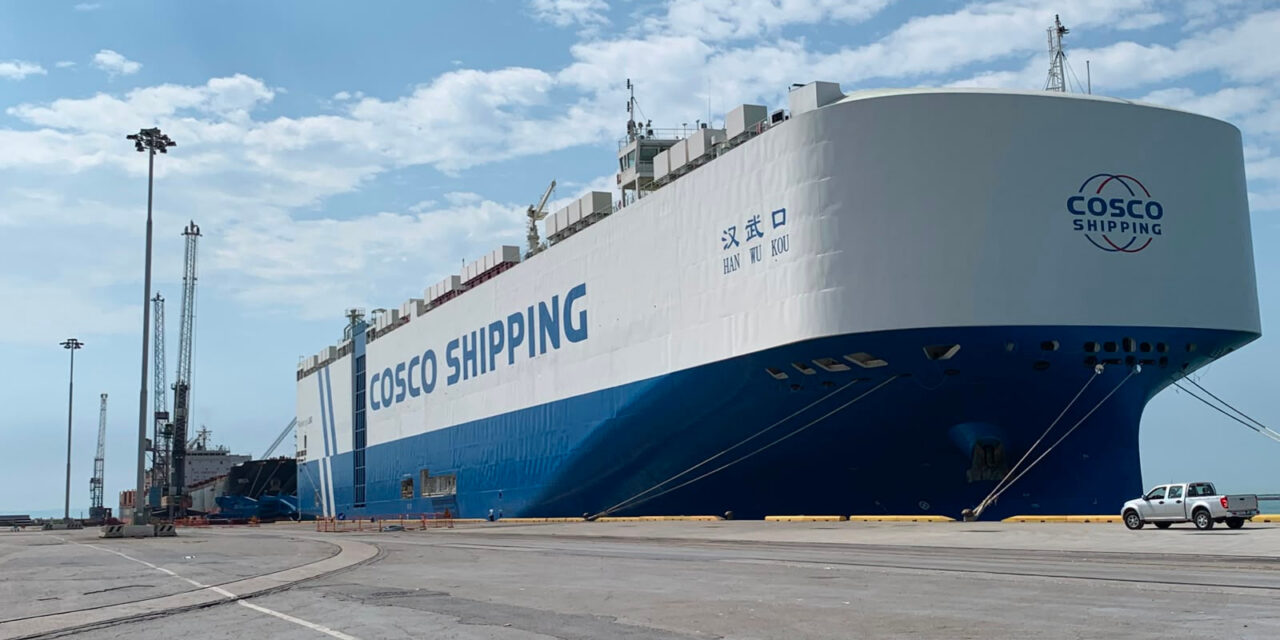
MONFALCONE – The port of Monfalcone has welcomed for the first time a Cosco Shipping car carrier: the Han Wu Kou arrived at the Cetal terminal (Grimaldi Group) to discharge 3,299 cars made by the Chinese manufacturer BYD.
This was a one-off call rather than the launch of a regular service, but the operation still represents an interesting signal for the port and for the automotive terminal operated by Cetal. BYD is in fact distributing its vehicles through several European ports to assess the most efficient and competitive logistics solutions, leaving open the possibility that some of the current spot operations could turn into stable traffic flows.
The Monfalcone terminal operator remains cautious. The operation is described as the result of cooperation between Cosco, the Customs Agency and Cetal, which made it possible to handle the discharge of the vehicles from China without any particular critical issues. For the port of Monfalcone, this is a significant debut. It is the first time that a car carrier operated by the Chinese shipping company Cosco has called at the port, confirming the growing interest of international operators in Upper Adriatic infrastructure and in the port’s ability to serve the automotive market.
According to Davide Calzavara, director of Cetal, the arrival of the Han Wu Kou shows that the terminal still has the capacity needed to absorb additional volumes without affecting the management of its already consolidated traffic, including flows developed with the Grimaldi Group. With the discharge of the BYD vehicles, the areas are now almost fully occupied, but the operation was handled without any particular operational problems.
Looking ahead, possible developments in new automotive traffic could also find room thanks to the opportunities offered by the new Port Master Plan, which would allow the dedicated areas to be expanded. This, however, would require specific investment and is currently considered premature. The rail component is also seen as one of the decisive factors for the growth of this segment. The availability of efficient rail connections is in fact one of the key factors in attracting and consolidating international automotive traffic, allowing vehicles to be distributed quickly towards Central European markets.