

TRIESTE – Trieste is the Italian port at the centre of the Italian Maritime Economy 2026 report by SRM, the research centre of the Intesa Sanpaolo Group.
Of the report’s 182 pages, an entire chapter is devoted to the role of the Port of Trieste within the India-Middle East-Europe Economic Corridor (IMEC), regarded as one of the key projects set to reshape trade routes between Asia and Europe.
The chapter, authored by Stefano Visintin (President of Confetra FVG), bears a title that leaves little doubt about the report’s approach: “IMEC as geologistical insurance and corridor turned network. The key role of Trieste”. According to the authors, the project should not be seen simply as an alternative corridor to the Suez Canal, but rather as a resilient logistics network capable of providing alternative routes in the event of geopolitical crises or disruptions to major maritime trade lanes. Tensions in the Middle East and the challenges that have emerged in recent years are presented as evidence of the need to build more secure supply chains that are less dependent on a single trade route.
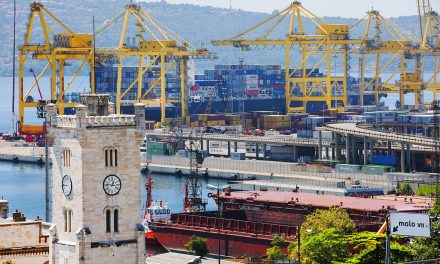
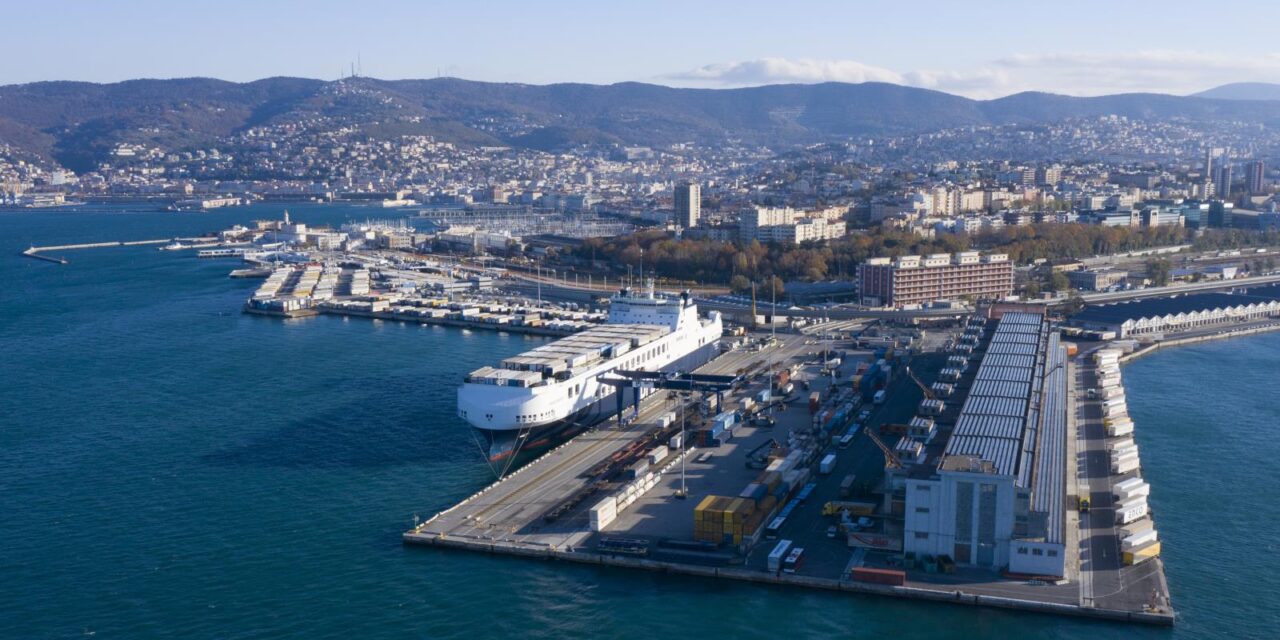
According to SRM, Trieste has the characteristics required to become the main European gateway of the IMEC. The report highlights the port’s deep-water draughts, its strong integration with the rail network serving Central Europe, its strategic location at the intersection of the TEN-T corridors and its well-established international vocation. In the maps included in the report, Trieste is identified as the European reference hub of the new corridor.
The analysis also points out that cargo flows generated by the IMEC would be destined primarily for Central and Eastern European markets rather than Mediterranean transhipment activities. This feature would make Trieste particularly competitive compared with other ports, thanks to its ability to rapidly route cargo towards Austria, Germany, Hungary, the Czech Republic and other countries across its European hinterland.
The authors believe that the port could capture a significant share of the traffic generated by the new corridor, also benefiting from the possible free trade agreement currently under negotiation between the European Union and India. The report notes that the IMEC could reduce transport times by up to 40% compared with traditional routes and support trade worth an estimated €170 billion between Asia and Europe.
Considerable attention is also devoted to the Ro-Ro sector, one of the port’s long-standing strengths. SRM underlines that Trieste is already Europe’s leading hub for maritime services with Türkiye and suggests that this role could be further strengthened within the IMEC framework. The report recalls the current throughput of approximately 350,000 intermodal transport units (ITUs) and forecasts growth to 500,000 units by 2030 and 625,000 by 2040. Among the proposed developments is also a future short sea shipping service between Trieste and Israel.
To support this scenario, however, SRM argues that the capacity of landside infrastructure will need to be expanded. In addition to the rail investments already planned, the report proposes the construction of a new railway line of approximately 25 kilometres between Monfalcone and the Port of Trieste, considered strategic for supporting traffic growth and strengthening the port’s role within both the IMEC and the TEN-T network. The report also notes that an initial operational route already exists.
It describes a connection between Trieste and Dubai via Haifa, Jordan and Saudi Arabia, with a transit time of approximately 16 days. While acknowledging the remaining challenges, particularly in terms of customs procedures and infrastructure, SRM considers this route a viable alternative in the event of disruptions along the traditional routes through the Suez Canal or the Strait of Hormuz.
The 13th Italian Maritime Economy Report by SRM also highlights how geopolitical tensions in the Strait of Hormuz, the Red Sea and the Suez Canal are reshaping global trade geography, prompting shipping companies and logistics operators to rethink routes and supply chains. Against this backdrop, the Mediterranean is strengthening its strategic role: in 2025, the region’s main container ports handled more than 72 million TEUs (+5.9%) and, according to the report’s forecasts, traffic will grow by a further 15% by 2030, outpacing the global average.
For Italy, the report underlines the need to support this growth through investments in rail connections, last-mile port infrastructure, maritime accessibility and port digitalisation, identifying rail-sea intermodality as one of the country’s main competitive advantages. The presentation of the report was also attended by Marco Consalvo, President of the Port Network Authority of the Eastern Adriatic Sea, who took part in the panel dedicated to ports, logistics and intermodality in the new Mediterranean corridors, alongside representatives of FS Logistix and the Italian Coast Guard.