

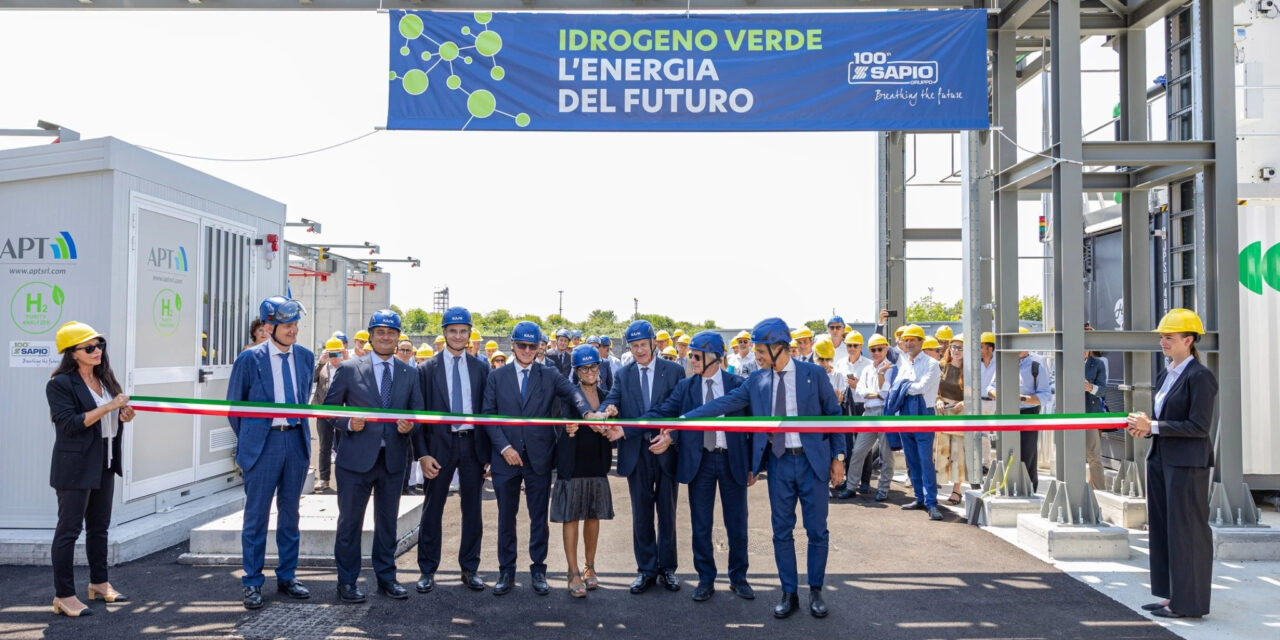
TRIESTE — The Sapio Group’s new plant for the production of renewable hydrogen has begun operations in Porto Marghera.
The new plant, inaugurated one year after the laying of the cornerstone, is one of the largest in Italy for the production of certified renewable hydrogen compressed to 500 bar. Built with PNRR funding of approximately 17 million euros, it has a production capacity of up to 750 metric tons per year. Contracts have already been signed for the supply of 50 metric tons of hydrogen in 2026, intended specifically for the decarbonization of local public transportation and the automotive sector. The project also includes the photovoltaic system built by ECO+ECO, a Veritas Group company.
The opening ceremony yesterday was also attended by Roberto Mantovanelli, Secretary General of the Northern Adriatic Port System Authority, who highlighted the agency’s role in promoting industrial investment in Porto Marghera. According to Mantovanelli, the Port Authority should not limit itself to managing existing infrastructure, but should create the conditions that allow companies to invest with stability and long-term prospects.
In his remarks, Mantovanelli highlighted some of the major infrastructure projects designed to bolster the area’s competitiveness. These include improving maritime accessibility through work on the Malamocco-Marghera Canal—which can begin once the environmental impact assessment process is complete—and enhancing land-based connections through progress on the new railway bridge and the Montesyndial multimodal project.
Mantovanelli also highlighted the importance of the administrative streamlining measures offered by the Simplified Logistics Zone (ZLS), which are seen as a tool for expediting permits and making the area more attractive to new industrial investments. This is complemented by the Port Authority’s commitment to securing financial resources to support innovative projects and to enhancing the industrial and logistics infrastructure developed in Porto Marghera over more than a century of activity.
Among the factors considered crucial to the construction of the facility, the following was also cited: collaboration between public and private entities. The project has its roots in the memorandum of understanding signed five years ago between the Port Authority, Sapio, and Hydrogen Park , which was subsequently developed with input from the relevant ministries, the Veneto Region, and resources from the PNRR.