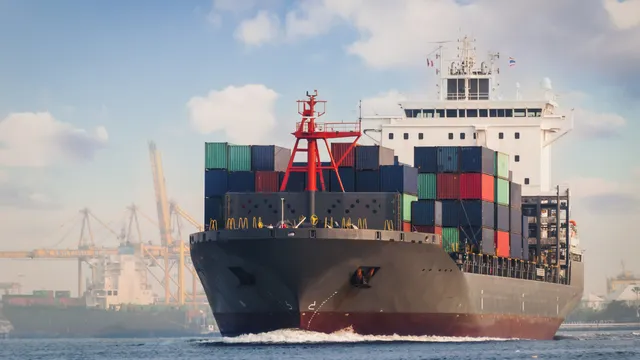


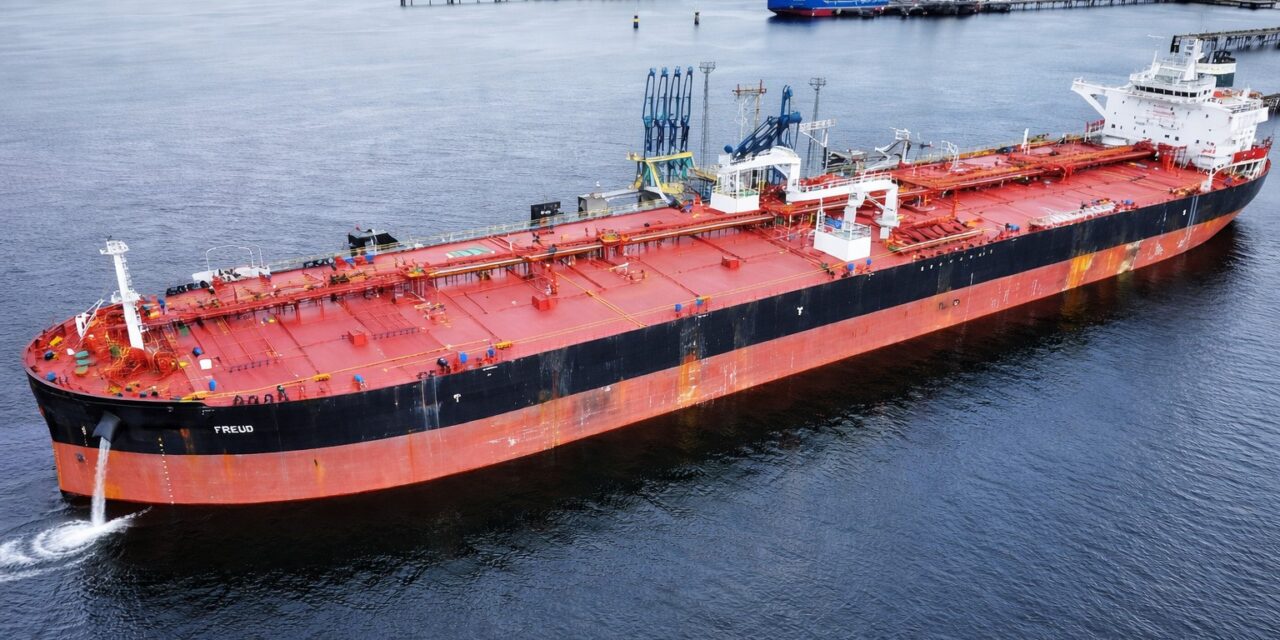
TRIESTE – The tanker Freud (IMO 9804461), due in the port of Trieste on 20 January, may be among the four vessels hit in recent days in a drone attack in the Black Sea.
The unit, operated by Greek company Tms Tankers, reportedly suffered limited damage and has already resumed its voyage towards the Friuli Venezia Giulia port, bound for the Siot terminal. The Freud is carrying CPC Blend, a crude mix predominantly of Kazakh origin, which is essential to feed the Transalpine Pipeline. The last recorded call dates to 22:00 yesterday at the Turkish Bosphorus North anchorage, off the strait of the same name.
At the time of the attack, the tankers were at anchor, waiting to load crude oil, at the Caspian Pipeline Consortium (CPC) offshore terminal near Novorossiysk. According to Greek maritime security and risk management firm Diaplous, as reported by the Greek press, the three ships whose involvement is said to be confirmed are the MT Matilda (IMO 9407457), managed by Thenamaris and flying the Maltese flag; the MT Delta Harmony (IMO 9408463), Liberian-flagged and managed by Delta Tankers; and the MT Delta Supreme (IMO 9585895), also under Delta’s management. The Freud is no longer included in reports of confirmed attacks.
Information on the incident remains fragmentary. There is currently neither an official assessment of the extent of the damage suffered by the tankers involved nor details on the type of drone used.
The CPC terminal, according to Bloomberg and Maritime Executive, is operating at reduced capacity (around 800–900 thousand barrels per day versus the usual 1.7 million) due to previous damage and maintenance work underway.
The new attacks come at a particularly sensitive moment for the region’s energy supply chain.
At the start of January, Kazakhstan’s output fell significantly, and the increasingly frequent incidents in the Black Sea could, according to maritime agencies, lead to increases both in freight rates and in insurance premiums for tankers loading at Russian terminals, through which more than 2% of global crude production passes.
This would therefore no longer be an isolated incident, but a now entrenched threat to maritime security in the Black Sea.