

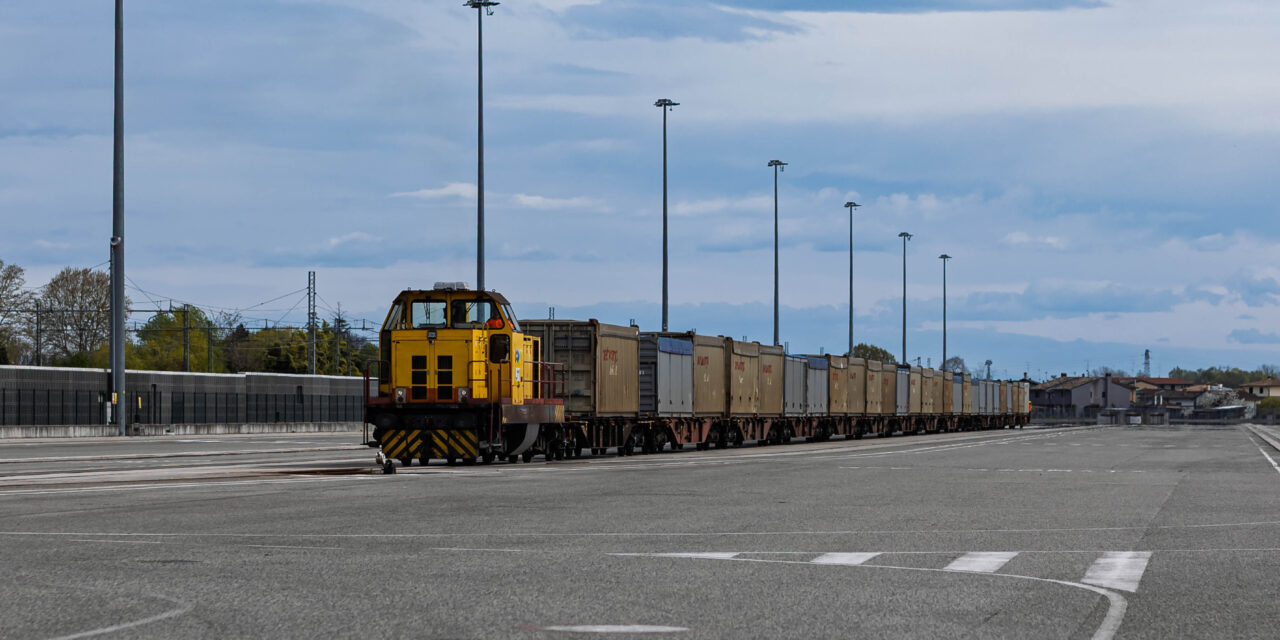
TRIESTE – The departure of the first InRail train marks the operational return of the Pordenone Interporto intermodal hub and represents the key moment of the उद्घural day.
The convoy is the first service operated directly by InRail after the transition phase that followed the end of the relationship with Hupac. This is not just a symbolic step: in recent years the hub had lost centrality in rail traffic, and the restart of train services is the real indicator of its reactivation.
The partnership with InRail, already active within the North Adriatic logistics system, makes it possible to restore rail links that are essential for local businesses and reconnect the interporto to the European corridors.
This operational step comes alongside the inauguration of five new infrastructure works worth more than €6 million in total. The projects involve the expansion of yards, new certified parking areas and spaces dedicated to services, with an overall redesign of the hub’s logistics layout. The interporto, which covers around 895,000 square metres, is at the centre of a broader development plan. Works under way include the extension of the rail siding to 750 metres, the expansion of the container terminal and the creation of new logistics areas. At the same time, full digitalisation of flows is planned by 2026, with systems for monitoring access and vehicles.
The link with the Port of Trieste remains central, with the aim of strengthening its role as a hinterland terminal and improving integration between maritime and rail traffic. In this framework, there is also the prospect of terminal management through a public-private company, to bring the hub to full operating capacity. The day brought together institutions, operators and businesses, with one shared message: without rail, there is no logistics competitiveness.
The main speeches at today’s ceremony highlighted a few key points:
Interporto Pordenone chief executive Sergio Bolzonello underlined the role of the interporto as a logistics node in a strategic position between Veneto and Friuli Venezia Giulia, connected to ports and European corridors. He also highlighted the importance of digitalisation in improving safety and competitiveness.
InRail, through chief executive Martin Ausendorfer, stressed the value of cooperation in the rail sector and the competitive advantage of rail over road, especially in terms of efficiency and resources.
Michelangelo Agrusti, vice-president of the Pordenone-Udine Chamber of Commerce, recalled the link with Trieste, indicating Pordenone as part of the hinterland port system and underlining its potential also in the broader logistics sphere, including the military sector.
Alessandro Basso, mayor of Pordenone, spoke of a positive phase for the area and of a growing local system, while Minister for Relations with Parliament Luca Ciriani reiterated the weight of logistics for industrial competitiveness and the need to support the sector in a complex economic context.
Massimiliano Fedriga, president of the Friuli Venezia Giulia Region, placed the emphasis on the strategic vision: investments in the interporto are not local in scope but serve a wider logistics system, regional and European, with Friuli Venezia Giulia as a hub between East and West.