

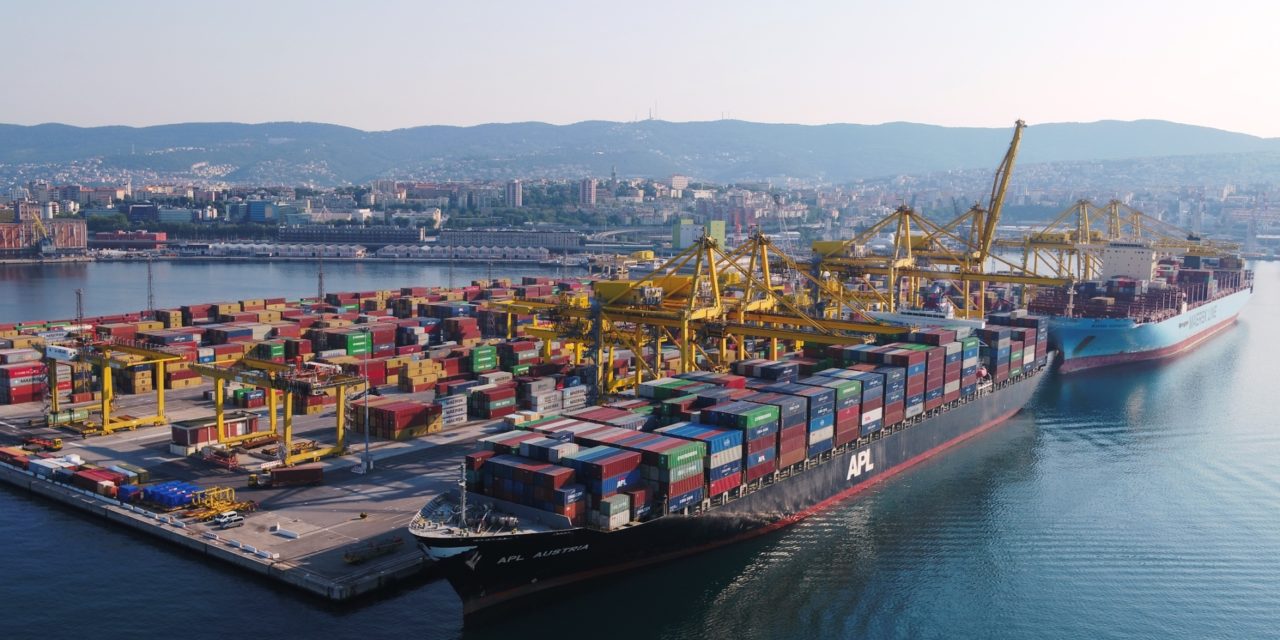
TRIESTE – Growing interest, and clear indications on the next steps needed to give substance to the Indo-Mediterranean Corridor (IMEC), which could see the port of Trieste as one of Europe’s main hubs. In March, another meeting—again in the capital of Friuli Venezia Giulia—for further developments on the topic.
This was the message launched by the “two-day” Trieste Indo-Mediterranean Business Forum, which ended yesterday at Trieste’s Porto Vecchio.
A long series of contributions—both institutional and from companies that brought concrete examples of their interest in developing routes between India and the Adriatic, via the United Arab Emirates, Jordan and Israel—shaped the panels.
But in recent days it was Carmelo Barbarello, IMEC Coordinator on behalf of the Ministry of Foreign Affairs, who outlined the current state of the initiative.
Barbarello stressed that, while Israel and Jordan are not signatories to IMEC, the issue of normalising relations between Arab countries and Israel remains on the table, and therefore so does the stabilisation of the situation in the Middle East.
«We’re seeing a relaunch of the countries involved, also taking cues from the ceasefire in Israel» he noted.
The new conditions for giving the project a push refer to the European Union’s strong commitment to the initiative and to the possibility of making available Global Gateway mechanisms, with access channels to funding that can make specific projects feasible.
«Italy is working to place IMEC within the same logic as the Mattei Plan. Some projects have already started, such as the fibre-optic cable between Genoa and Mumbai or the simplification of customs procedures. IMEC, moreover, is equipping itself with internal governance and then with a number of working groups. Gaps will have to be identified, and then the first projects determined» Barbarello explained.
Digital, trade and energy will be the three pillars, but one group will be dedicated specifically to funding, which will not come from a single source but will be provided by private players and banks, as well as the public side.
«Trieste remains strategic and central for the Italian Government. But we no longer talk about a Corridor, we talk about Corridors. You can’t—he explained—avoid talking about a network, with multiple ports of departure in India and multiple ports of arrival in the European Union».
Another focal point, mentioned in various contributions at the conference and also in recent days by the new president of the Trieste Port Authority, is the need to find synergies with nearby ports in Slovenia (Koper) and Croatia (Rijeka).
These points were taken up again in the concluding part of yesterday’s session by Francesco Maria Talò, Italy’s special envoy for IMEC.
Talò announced a more technical phase, in which engineers, financial experts and economists will have to identify the necessary interventions and assess their competitiveness.
«The Indo-Mediterranean corridor today is no longer just an ambition limited to operators or indirect players, but an international project backed by the Italian Government. The alliance with institutions, combined with the strategic value of this major trade route, fits into an operation that represents an unmissable economic opportunity for all of Europe. Our task is to strengthen the link with India and the Gulf countries also from a commercial standpoint: in this path Trieste is the gateway into the Continent and an essential connection».
This is what the governor of Friuli Venezia Giulia, Massimiliano Fedriga, stated in his speech yesterday at the convention centre in Porto Vecchio, Trieste.
According to Fedriga, all countries that reach the Mediterranean through India look to IMEC as the only way to reinforce links between East and West. The corridor could protect an entire area that, with the opening of polar routes, risks being cut out of global trade. It would therefore be a political choice of transatlantic significance, useful for strengthening international relations that run from the Indo-Mediterranean axis all the way to the United States.
«We must be aware—Fedriga continued—that Friuli Venezia Giulia, through the ports of Trieste and Monfalcone and thanks to its geographic position, can be the heart of this project, maximising the economic convenience of routes coming from the East. With this in mind, we must pursue two fundamental objectives: formalise institutional agreements and move forward with the investments needed to turn IMEC’s answers into reality in the years ahead».
Finally, the governor confirmed the Region’s commitment both on the economic front and on that of international relations.