

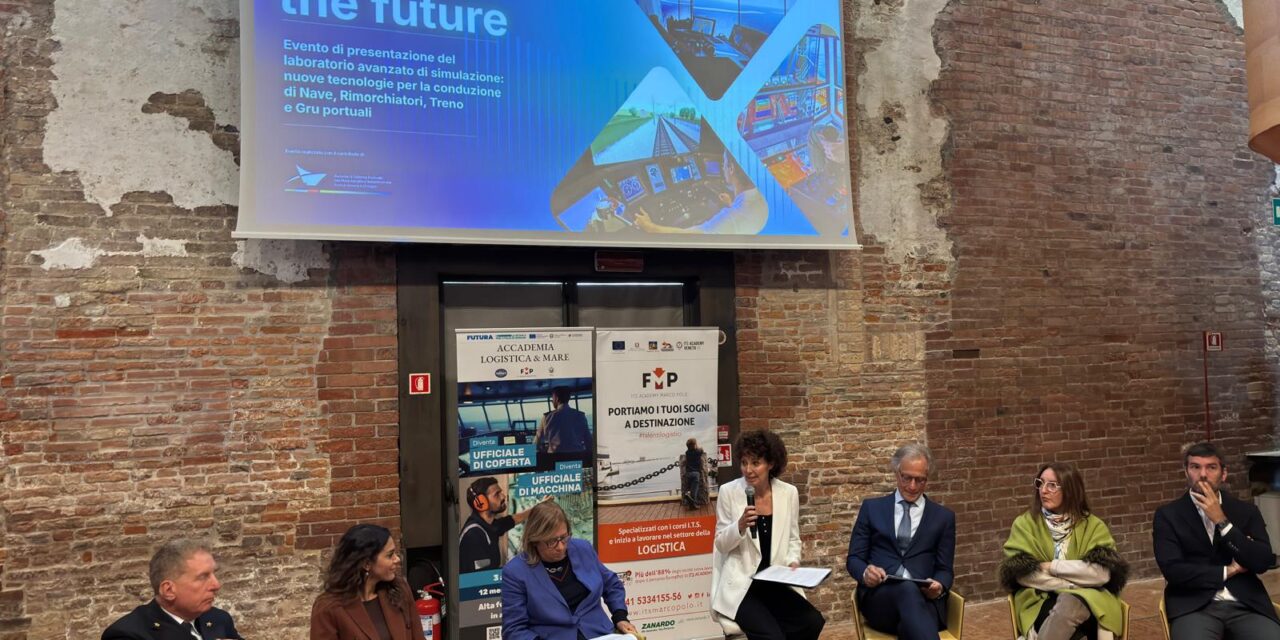
VENICE – The complex actions performed by ship captains, crane operators, train drivers and tug crews will no longer seem so daunting: the ITS Marco Polo in Venice, located opposite the Port Authority, has introduced a new way of conceiving education. Today, four new simulators were unveiled, combining learning with a safe environment where students can make mistakes without fear.
This is a €4 million investment, funded through Italy’s National Recovery and Resilience Plan (PNRR), which brings the institute’s training offer up to international standards.
As for the maritime simulator, the recreated bridge is surrounded by two-metre-high screens replicating the view from a ship’s command cabin. It is easy to feel immersed in ship handling — though beware of the weather, because when a storm hits, even standing still on the floor gives the uncanny sensation of “swaying.” The same applies to the tugboats, trains and cranes, although the latter two have slightly different workstations.
For the train simulator, the seat allows trainees to operate all controls while watching a large monitor displaying real railway routes, with the option of adding some “spice” — such as sudden fog or a technical fault. The crane simulator, located on an elevated platform to accustom students to working at height, allows them to replicate container-handling operations both dockside and at height, including specific situations unique to Porto Marghera.
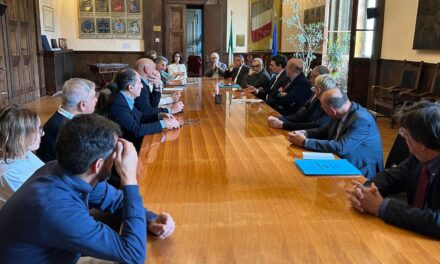
The presentation took place today in Santa Marta, in front of the North Adriatic Sea Port Authority, with the attendance of Prefect Darco Pellos, Elena Donazzan, vice-president of the European Parliament’s Committee on Industry, Research and Energy, Paola Frassinetti, Undersecretary at the Ministry of Education and Merit, Valeria Mantovan, Veneto Regional Councillor for Education, Andrea Tomaello, Deputy Mayor of Venice with responsibility for the Port, Rear Admiral Filippo Marini, Commander of the Port of Venice and Regional Maritime Director of Veneto, and Damaso Zanardo, president of the Logistics & Sea Academy, which also includes the Intermodal Logistics Training Centre (CFLI).
Absent for institutional reasons, the Port Authority’s special commissioner Matteo Gasparato conveyed his message in a welcome letter, emphasising the need for dialogue among logistics operators to foster synergies throughout the supply chain.
Zanardo highlighted the ITS’s progress over the past decade, expanding from a single course to the ten planned for next year: «The presence of such innovative tools demonstrates that we truly are an educational and cultural hub, able to listen to companies and respond to their needs. Today, our employment rate — referring to graduates finding work within a year — already exceeds 93%. With these technologies, we can further reduce the gap between the demand and supply of highly specialised professionals».
According to Donazzan, the Marco Polo will «help retain young people in the region while giving them an international outlook and experience. The ITS programmes provide advanced technological training closely connected to the business world and capable of responding to the constantly evolving needs of the economic and production sectors. The inauguration of the simulators at the Logistics & Sea Academy is concrete proof that the ITS model can innovate and look to the future: unique tools in Italy that prepare our young people for real-world work scenarios, reducing the gap between education and employment».
Marini focused on the concept of safety, noting that «For the maritime authority responsible for safety, it is an added value when trainees are familiar with these tools and technologies. Venice, with its history and maritime centrality, is the ideal place to host training systems of this scale. But their value extends well beyond the Lagoon: students training on these simulators today may tomorrow be working aboard ships and in ports around the world».
Tomaello stressed that this initiative shows Venice is not only a city of tourism monoculture but also one capable of offering its citizens real opportunities that prevent brain drain.
Mantovan pointed out that Veneto’s education system is gaining a new asset: «The inauguration of the new Simulator Hub at the Logistics & Sea Academy marks a major achievement not only for Venice — a city with a historic maritime vocation — but for the entire Veneto education system. With these simulators, we are not only celebrating a technological investment, but reaffirming a vision: giving our young people concrete tools to become active players in the world of work, while offering companies highly specialised skills».
Frassinetti concluded by noting that «The government has strongly supported the ITS system,» which is the «proof that the 4+2 education reform (four years of vocational training plus two of ITS specialisation) can be implemented with confidence.» In this way, it will be possible to «qualify young people, prevent brain drain, and ensure that companies can tap into high-quality talent emerging from these programmes».