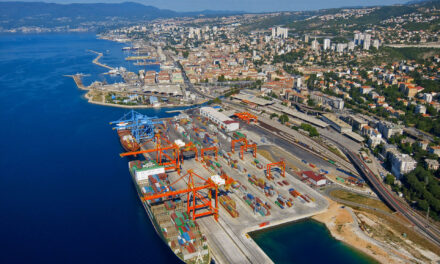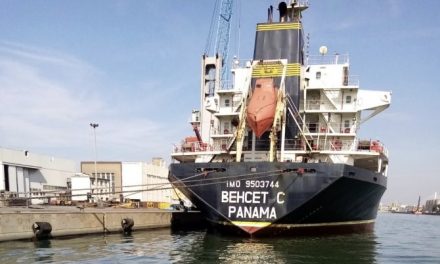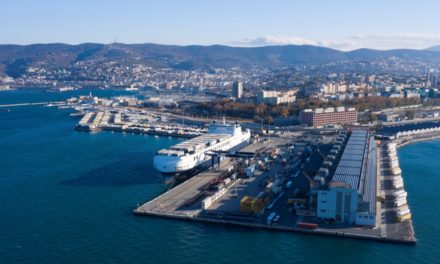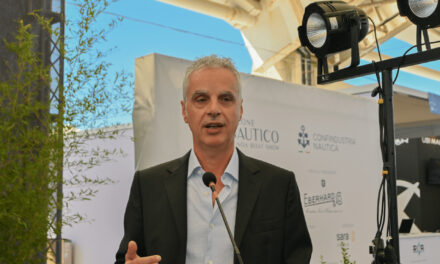


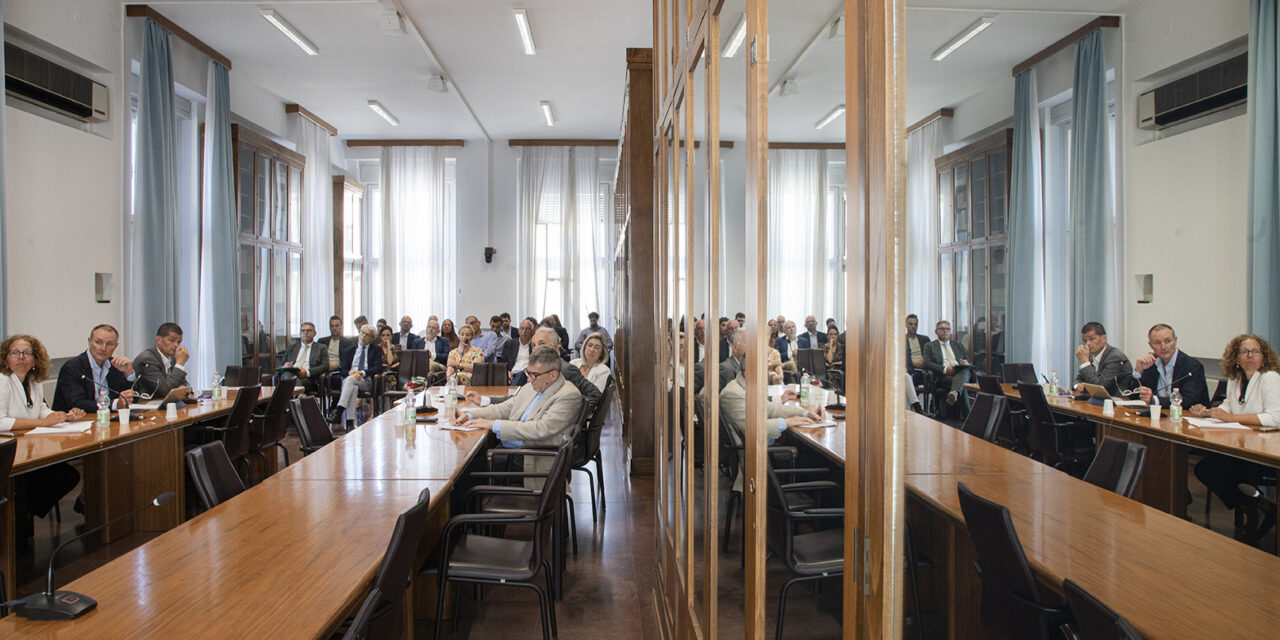
TRIESTE – Digitalisation through a system acting as a single window for the Northern Adriatic ports, road and rail logistics interoperability, joint international port promotion, especially outside Europe, and environmental sustainability projects focused on quay cold ironing.
These were the ideas that emerged from operators and maritime law academics at the Adriaports FORUM organised in collaboration with the university, held today at the University of Trieste.
A technical focus on the regulations governing the ports of Trieste, Koper and Rijeka, during which all the differences regulating the individual ports emerged, but from which the «need» to cooperate also became clear, in order to support the joint development of the ports while maintaining mutual competitiveness. «Selective coopetition» was the term coined yesterday by the first speaker, Professor Giuseppe Borruso of the University of Trieste, and then adopted by all the others.
The morning of discussion organised by Adriaports together with the University and Confetra FVG was made necessary by the debate on possible forms of cooperation between the main Northern Adriatic ports, which periodically reignites, driven by traffic growth, infrastructure investments and international competition.
Regional councillor for Infrastructure and Territory Cristina Amirante linked the theme of the meeting to the States General of North-East logistics, recalling that the IMEC corridor (India-Middle East-Europe Economic Corridor) is considered one of the main development opportunities for the port and logistics system of the Northern Adriatic. Amirante highlighted the need for an integrated vision involving the Italian ports together with Koper and Rijeka, while also stressing the difficulties created by different national regulations. According to the councillor, moreover, alongside the necessary political will, the efficiency of the system lies in the ability to guarantee «infrastructure redundancy, within a dynamic of fair and genuine international cooperation, in which everyone must do their part». «The networks supporting our ports», she said, «must be able to absorb traffic peaks, interruptions or construction sites, ensuring the continuity of the flows needed for the vitality of the ports. Since the construction of new infrastructure requires long timeframes and substantial funding, the winning strategy consists in bringing together the existing logistics networks of different regions and countries».
On the issue of necessary cooperation between ports despite differing regulations, Professor Borruso argued that «precisely because of the geographical proximity of the three logistics and port systems, where competition is inevitable, integration and cooperation become necessary. A form of selective coopetition». Because ultimately the logistics chain is the same, with the same risks of line saturation.
Professor Iva Tuhtan Grgić of the University of Rijeka explained that the port consists of two terminals, the old one and the new one, and that they are in competition. She also noted that in Croatia, where maritime state property exists as in Italy, port authorities have been created to «regulate the delicate balance between competition and cooperation for the development of ports». As in Italy, Zagreb has chosen port authorities as the instrument that regulates concessions and is funded by port dues, state funds and EU funds, while dealing with infrastructure.
The situation in Koper is completely different, as Professor Mitja Grbec of the University of Primorska later explained, where the port is managed by Luka Koper, a de facto public entity. Administrative management lies with the competent ministry, while commercial management is entrusted to Luka Koper, whose shareholding is predominantly public.
A real «case» in Europe, maintained through the updating of the old contract with a new one under EU rules, but which will have to be renegotiated in 2043.
It is Slovenia’s only commercial port, where rail traffic reaches 50% and which handles 23 million tonnes of goods. It is managed through a dual model: the state deals with the rules, Luka Koper with the commercial side.
Similar to Croatia is the organisation of the port of Trieste, regulated, like other Italian ports, by Law 84 of 1994, as explained by Professor Massimo Campailla of the University of Trieste. «Selective competition will soon be put to the test on cold ironing, that is, the supply of electricity to ships berthed at the quay. In this area, the different legislative systems, combined with the strong disparity in energy costs, could create diseconomies for some ports to the benefit of others, generating competitiveness where the shared objective should instead be solely greater environmental sustainability», Professor Campailla concluded.
The final contribution came from operators, in particular from Čedomir Bojanič, president of the Transport Association of the Chamber of Commerce of Slovenia, who explained that there is already maximum cooperation between Italy and Slovenia in the sector, calling for joint work on several fronts. «Digitalisation with a single trade digital corridor between the three ports, which economic operators can access to find the information needed to encourage them to use the Northern Adriatic ports. In other words, a platform with a single window», Bojanič proposed.
According to the Slovenian operator, all this fits perfectly within the perspective of the new European Customs Code, which provides for the creation of a single customs authority, the European Customs Agency, and centralised clearance procedures.
These are issues on which there was complete agreement with Confetra FVG president Stefano Visintin, according to whom, with the three current regulatory frameworks, the most immediate area of cooperation is among freight forwarders, who can jointly present the “single system” on various promotional occasions.