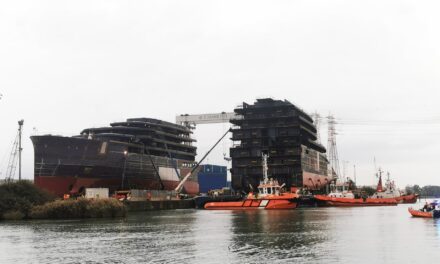


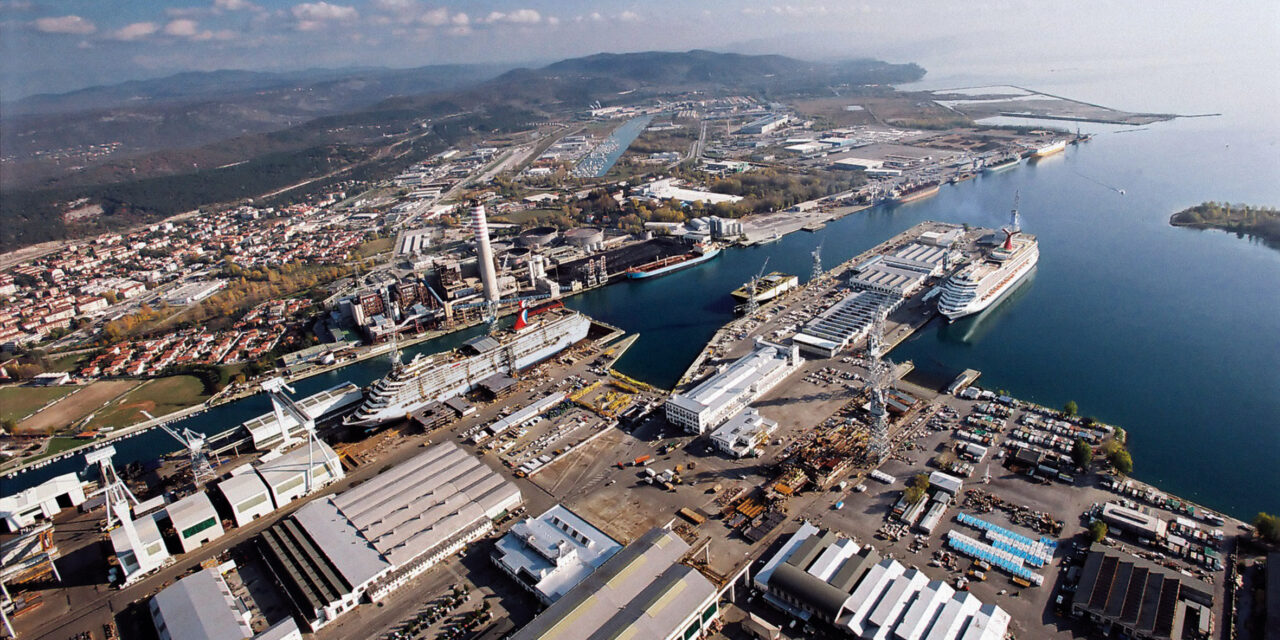
TRIESTE – Clash over the impact of shipbuilding in Monfalcone, between the municipal administration and Fincantieri, which has on the territory the group’s largest shipyard with thousands of workers.
The City Council approved, in bipartisan fashion (unanimously with 21 votes out of 21 councillors), a motion requesting from Fincantieri a «new production model». The motion, first signatory Anna Maria Cisint, MEP of the Lega, former mayor of Monfalcone and currently delegated to security and the fight against Islamic radicalisation in the Municipality, was supplemented with some proposals from the opposition. It argues that «production expansion risks exacerbating the fragmentation of labour and the use of subcontracting, with social and housing repercussions for the territory». Cisint stressed that it is «a turning point to protect the value of work and of workers», thus «this motion is not a point of arrival, but the beginning of a dispute which sets in motion a process that will have to translate into concrete actions».
Harsh was the response, in a letter published in full by the newspaper Il Piccolo, from Fincantieri’s CEO and General Manager Pierroberto Folgiero.
«Despite a municipal administration that seems intent on continuing to explain to us our “production model” — that is, how a ship is built, with which resources or corporate arrangements, even with which companies — we have launched a series of concrete social-responsibility projects, including for example the opening of a nursery, which take very seriously the impact of our shipyard workers on a city built by the Cosulich brothers around the yard about 110 years ago» wrote Folgiero.
In the Fincantieri plant the workforce is predominantly composed of workers from Southeast Asia (particularly Bangladesh), who make up a substantial share of the Monfalcone population (one third of 30,000 inhabitants), a factor against which former mayor Cisint has long fought.
The City Council identified eight «priority» points for discussion on «social impact on the territory, revision of the production model, investment in training and technology, overcoming structural reliance on low-cost non-EU labour, reform of the subcontracting system, corporate social responsibility, protection of legality and workers’ rights, and strengthening of local welfare».
Folgiero recalled that Fincantieri produces «around 3 billion euros of GDP in Friuli Venezia Giulia» and that it «creates an industrial chain for hundreds of Italian SMEs, 600 of them in FVG». The backlog «currently provides workload in the shipyards for the next 10 years and is worth 57 billion euros, over 80% of which statistically generates purchases in Italy for about 45 billion euros». Fincantieri «is looking for Italian workers, everywhere» and «around 23 million euros have been invested in the Monfalcone yard».
If Cisint replied insisting that «the CEO of Fincantieri cannot evade the obligation to address the consequences of his choices», many reactions urged caution. First among them, that of the governor of Friuli Venezia Giulia, Massimiliano Fedriga, who issued an «appeal for responsibility». «We have been working with Fincantieri for years» and «I believe that Fincantieri in recent years has shown a great sense of responsibility». Deputy Walter Rizzetto, FdI coordinator in FVG and chairman of the Chamber’s Labour Committee, also said that «institutional cooperation and responsibility are needed regarding Fincantieri, for the hundreds of small companies that make up the supply chain».
«I think it is wrong to bring Fincantieri onto the political battleground – said Fedriga – Fincantieri is an international player. We have been working with Fincantieri for years and I believe progress has been made also regarding the objective impacts on the communities where their companies are present. I believe that Fincantieri in these years has shown great responsibility by making important advances, and I am convinced this will continue»
The mayor of Monfalcone, Luca Fasan, reiterated «the need to revise the company’s production model starting from the use of subcontracting», which in his view «creates devastating consequences for the territory».
Harsh was the reply by Cisint herself: «Folgiero cannot barricade himself in the ivory tower of his strategic visions, which in the local context turn into dystopian designs if they are not correctly managed and governed». «There is not only corporate social responsibility incumbent on the company», she commented, «but also on those who have been appointed to lead it. The latter (Folgiero) cannot evade the obligation to address the consequences of his production choices when these affect a territory, especially if the flagship plant, the most prestigious and largest of the company, is located there». «The global strategies outlined by the group’s number one are not in question, but they are not a free pass for practices that alarm communities when they exceed social sustainability and transfer from the plant to the territory risks of legality linked to wage racketeering and the “Islamic pizzo”, which no longer seem to appear as isolated media cases».
For Cisint the issue is the lack of discussion «with the city» regarding the «ongoing expansion works» that will profoundly transform the company’s scale. Furthermore, the former mayor points to the consequences related to the requirements arising from the works. All this, according to Cisint, «justifies the belief that they may be even more severe than one might imagine for a community that already today cannot reconcile the burden of an uncontrolled non-EU presence».
Also the regional councillor for Labour, Alessia Rosolen, supports Folgiero: «It is precisely the social responsibility of the company», she underlined, «that has given birth to and grown Monfalcone, and the Region helps implement it also with the new social-innovation system».
Trade unions are divided. Michele Orlandini, FIOM CGIL secretary of Gorizia, agrees with the municipal motion, believing that subcontracting should be absorbed into the company. Meanwhile, Michele Zoff, FIM CISL RSU representative, notes that in other Fincantieri sites in Italy the problems raised in Monfalcone do not exist. He calls for the organisation of an inclusive table of company and unions to resolve the issues of a company that represents 53% of Friuli Venezia Giulia’s regional GDP.