

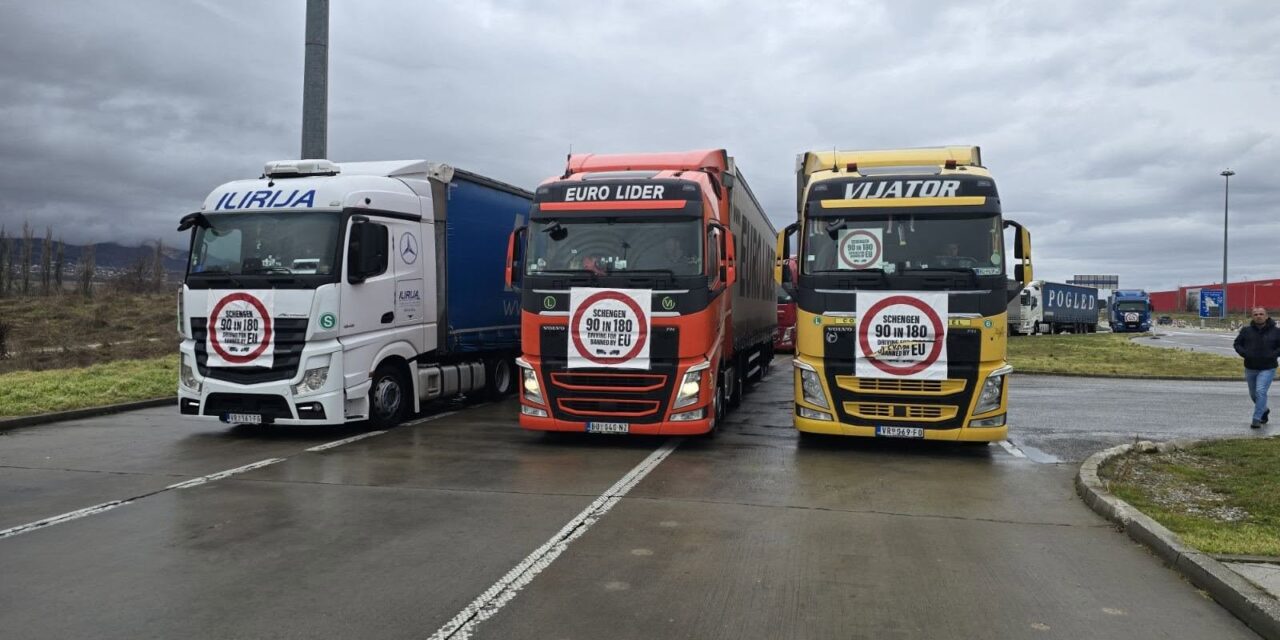
TRIESTE – Road haulage associations from the Western Balkans have launched a series of blockades at border crossings with the Schengen area, denouncing operational difficulties linked to a stricter application of the EU 90-days-in-any-180-day-period rule for non-EU citizens.
Among the promoters of the initiative is Poslovno udruženje “Međunarodni transport”, a Serbian association representing international road transport companies. The protests involve drivers and operators from Serbia, Bosnia-Herzegovina, Montenegro and North Macedonia, with slowdowns and temporary stoppages in freight traffic along some of the main corridors between the European Union, Turkey and the Middle East. The blockade, launched on 26 January and set to last at least seven days, includes exemptions for imports of medicines, the transport of live animals, ammunition and explosives.
According to hauliers, Schengen rules – now applied more strictly thanks to new digital systems for monitoring entries and exits – do not distinguish between time spent for work and personal stays, creating a structural problem for professional drivers regularly operating on EU routes. The Entry/Exit System (EES), operational since last 12 October and due to become fully functional by 10 April, electronically records entries and exits of third-country nationals crossing the external borders of the Schengen area for short stays.
The European Commission, through spokesperson Markus Lammert, confirmed it is aware of the situation, specifying that Brussels «is closely monitoring developments and is in contact with partners in the region» and that the hauliers’ protest is among the issues on the EU institutions’ radar. The Commission also reiterated that the 90/180-day rule is not new, but that the introduction of the Entry/Exit System makes checks more automatic and consistent at the Union’s external borders. «The new system does not change the existing rules, but it strengthens their enforcement».
At the same time, Brussels acknowledges that some non-EU professional categories, including international drivers, may face operational difficulties. «We are aware that certain sectors have specific needs for longer stays in the Schengen area», the Commission said, adding however that any exemptions would require appropriate legal instruments, such as specific visas or work permits.
For now, the European Union has not announced regulatory changes or automatic exemptions for non-EU drivers. The requests from trade associations – which for almost two years have been repeatedly appealing to the Commission to find a solution – have not yet received a concrete legislative response. According to organisers, the protests could be suspended only if guarantees are provided for the convening of a formal meeting with European Commission officials. In the background remains the fear of impacts on supply chains, in a key area for freight flows between Europe, the Balkans and Asia.