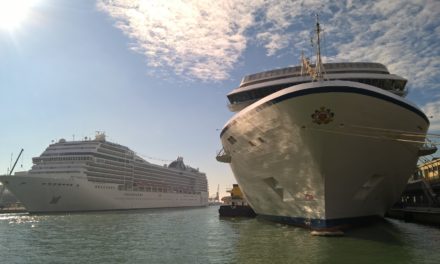


TRIESTE – The regulation of transits through the MOSE navigation lock is being welcomed by operators as a step that safeguards safety while also expanding the Port of Venice’s operational options.
«The decision by the Venice Harbour Master’s Office to regulate the use of the navigation lock is certainly good news. It is a wise choice, grounded in the principle of safety and, at the same time, it offers new development opportunities for the Port of Venice. In this way, it will be possible to overcome the limits that the MOSE inevitably imposes. Limits which, to be clear, we consider necessary for the good of our lagoon», Davide Calderan, president of Venezia Port Community (VPC), said about how the navigation lock will be managed.
According to Calderan, the initial precautionary approach is consistent with the complexity of the manoeuvres. Starting with ships of a certain size and progressively extending access to other vessel types will allow operators to gain experience in a controlled setting. Pilots, tug operators and mooring teams will play a central role in managing transits with the MOSE barriers raised, with the aim of ensuring high standards and service continuity.
On the economic side, VPC believes that access through the navigation lock will not entail costs that would discourage its use. The expertise required from the various professional roles should remain broadly in line with what is currently applied to vessels entering and leaving the port. In this way shipping companies will be able to opt for transit through the lock without waiting at anchorage for the barriers to be lowered again, limiting delays and impacts on operations.
For Calderan, the structured use of the navigation locks also represents a building block in the path towards a regulated-port model. An orderly management of flows during closure phases for exceptional high tides would allow the Venetian port to retain a central role in the national logistics system, in line with the direction set out by Deputy Minister for Infrastructure and Transport Edoardo Rixi.