

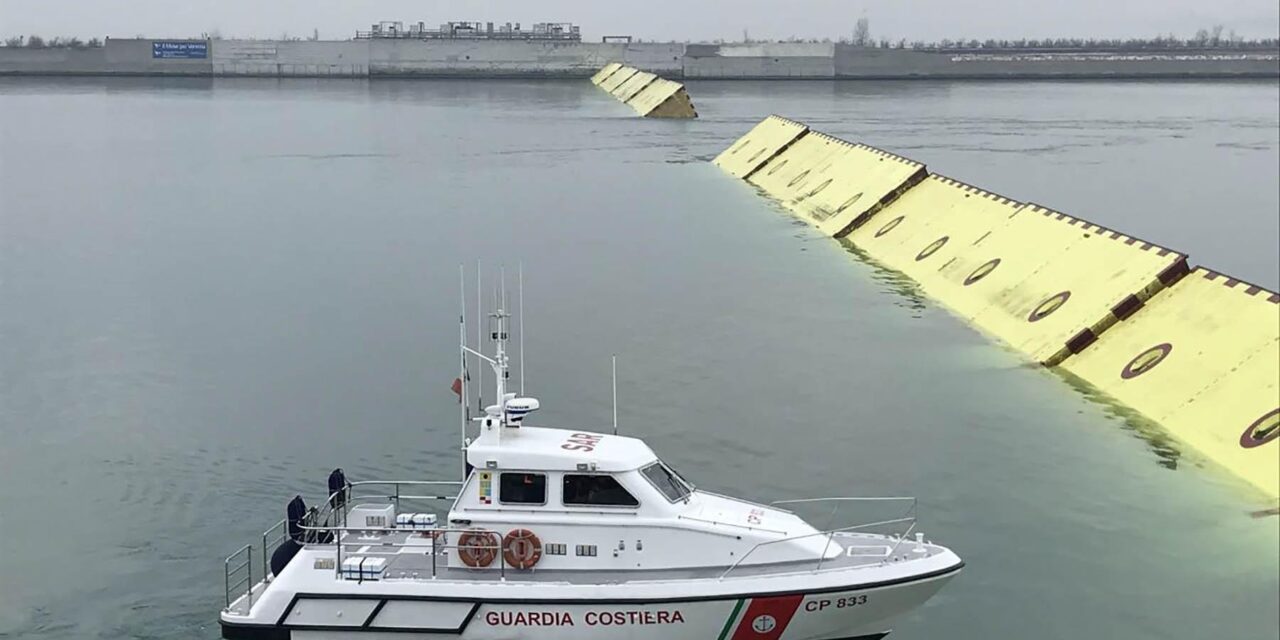
VENEZIA – Venice’s Harbour Master’s Office has issued an order regulating ship transits when the MOSE system is active in the Venice lagoon, in force as of yesterday.
As Adriaports reported in recent days, the decision had been in the air and concerned how to use the larger navigation lock—Malamocco—and the smaller one—Lido-Treporti.
Today saw an update to the “Regulations for the safety of navigation, anchoring, berthing and right of way of ships and floating units in the port and roadstead of Venice”. The regulatory framework will be “based on an experimental and progressive approach, so as to allow, on the basis of experience gained, any updates to the measures, always in the primary interest of navigational safety, protection of port infrastructure and environmental safeguarding”.
The measure states that, in the Lido-Treporti navigation lock, vessels up to 25 metres in length and 8 in lrghezza, with a draught of 3.50 metres, will be allowed to enter, provided wind is within the 20-I, II, III, IV knots – quadrant limit and visibility is 500 metres.
As for Malamocco, the limits are 140 by 26 metres, with a draught of 8.50, wind limits of 15 – I and III, or 20 – II and IV, with visibility of 2,000 metres.
The Coast Guard specified that “The measure sets out in detail technical criteria and operational conditions for the passage of naval units during the period in which the mobile barriers are raised, effectively overcoming the possibility of isolation between lagoon and sea when the flood-defence system is activated.” This is long-awaited news for sector operators, who see the management of a territorially regulated port drawing ever closer. Not by chance, the authority added that «with this measure, the Harbour Master’s Office consolidates a fundamental step in the operational integration between the Mo.S.E. system and ordinary port activity, ensuring continuity of maritime traffic even in the presence of high-tide events».
Another change, also signed by Commander Filippo Marini, Head of the Maritime District and Port Commander of Venice, concerns Article 10, i.e. berth scheduling. The amendment provides that “In the port and roadstead of Venice, the navigation of ships with a gross tonnage exceeding 50 tonnes and pleasure craft takes place according to the berth scheduling carried out by the Maritime Authority through the PMIS system”. Masters will therefore be required to submit the berthing/movement/departure notice “by 5.00 p.m. on the day preceding the navigation operations within the port area”. If this is not possible, it will be up to the authority to decide whether or not to accommodate the needs expressed. It will also be possible to specify a request to transit through the navigation locks when the MOSE barriers are raised.