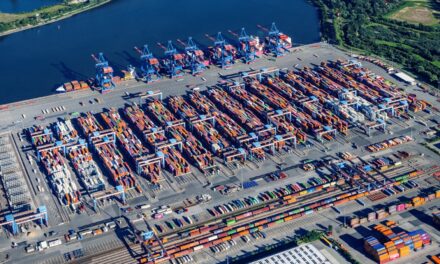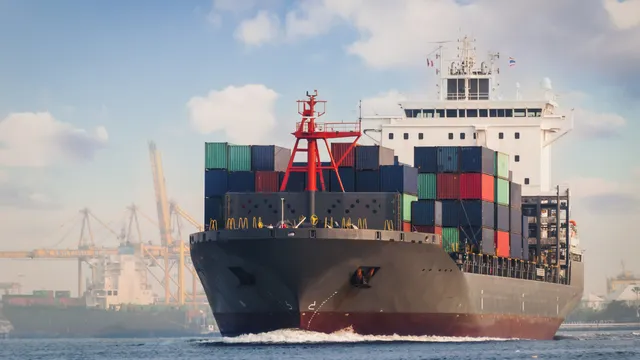


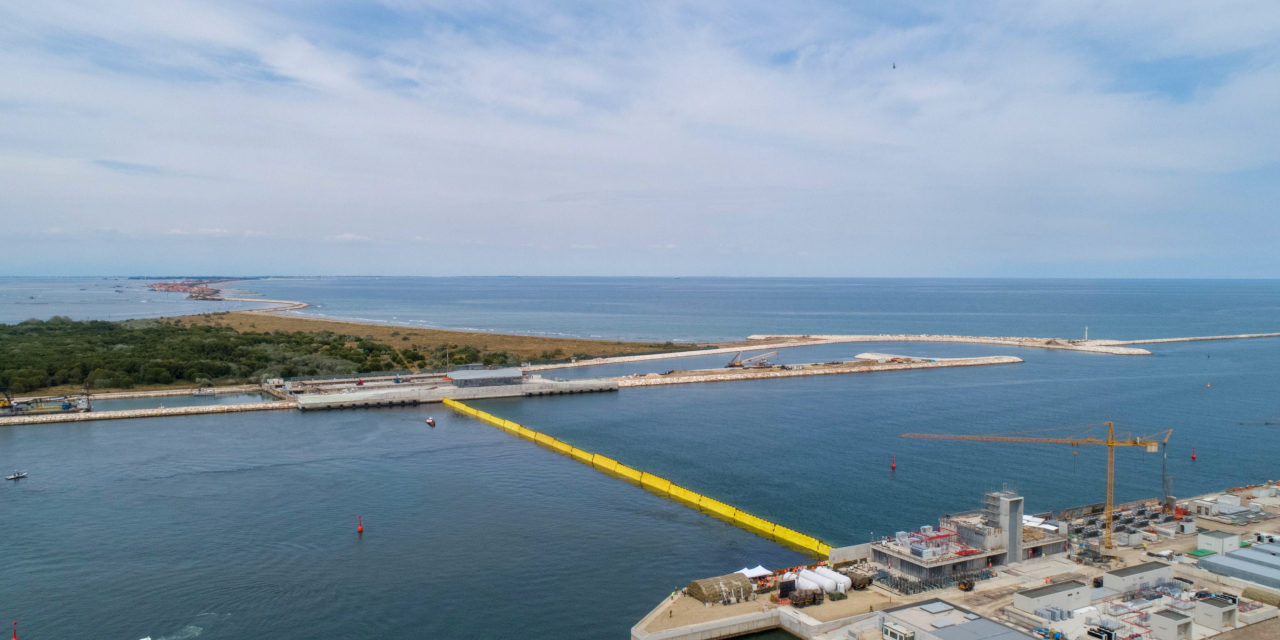
VENICE – Between 2020 and 2023, about one-third of the Mose system’s shutdowns could have been avoided without compromising Venice’s protection, saving approximately eight million euros.
This is the main finding of a study published in the journal *Nature Water*, conducted by the University of Padua, which proposes a more adaptive management model for harbor mouths—one capable of balancing hydraulic safety with the protection of the lagoon’s ecosystem, while yielding clear economic benefits.
Through numerical modeling of the 69 closure events recorded between 2020 and 2023, the propagation of the tide, lagoon currents, and wind effects were simulated, comparing the management approach actually implemented with an alternative strategy called AThOS.
Simulations show that in 30% of cases, the harbor inlets could have remained open without exceeding the safety thresholds set for the lagoon.
“We compared three scenarios: the lagoon with the harbor inlets always open, the MOSE management plan that was actually adopted, and an alternative, optimized strategy called AThOS,” says Alessandro Michielotto, a research fellow in Geosciences and the study’s lead author. “The latter aims to reduce the number and duration of closures, while still keeping water levels below the safety thresholds established for Venice and the main lagoon towns, including Burano and Chioggia.”
Fewer closures, more sediment on the salt marshes
One of the central aspects of the research concerns the effects of closures on salt marshes, vegetated surfaces that constitute one of the most delicate elements of the lagoon ecosystem. In fact, by limiting the inflow of tidal waters, the transport of sediments—which allow salt marshes to grow and counteract rising sea levels—is also reduced.
A More Adaptive Management of Harbor Inlets
By applying the AThOS strategy retrospectively to the events analyzed, the researchers estimate that it would have been possible to avoid about twenty of the 69 total closures, thereby also significantly reducing environmental impacts.
“Our results clearly show that the strategy adopted during the first years of the MOSE project’s operation was very cautious and strongly focused on preventing the risk of flooding.” Simulations indicate that the total annual duration of the closures was, on average, more than double what was strictly necessary to ensure urban protection. A strategy like AThOS, applied retrospectively to events from 2020 to 2023 and therefore not subject to the uncertainties inherent in management based on weather forecasts, shows that it would have been possible to avoid about 30% of the closures, that is, about twenty events out of a total of 69,” notes Luca Carniello, a professor in the ICEA Department at the University of Padua. With AThOS, the reduction in the area of flooded salt marshes would have dropped from 27.5% to 2.9%: sedimentation on the salt marshes would also have increased by 19% compared to what was actually observed, allowing for an average recovery of approximately 1.3 millimeters per year in vertical accretion, without compromising the protection of Venice and other urban centers in the lagoon.”
The study also highlights how the operational management of the MOSE project is already evolving compared to its early years of operation, thanks to the experience gained and the gradual refinement of forecasting systems.
The study’s coordinator, Andrea D’Alpaos, adds his perspective: “The management of the MOSE project appears to have already evolved gradually: this is an important point because it demonstrates that the management of the barriers is not static, but can be improved over time in light of the data, accumulated experience, and observed effects on the entire lagoon system.”
VPC: Conservation and the Economy Go Hand in Hand
Speaking on behalf of the Venice Port Community, President Davide Calderan emphasizes the impact of costs: “The future of our lagoon depends on the attention we pay to preserving it; at the same time, through scheduled closures based on actual flood risks, we could reduce the negative externalities associated with the economic activities of the ports of Venice and Chioggia. A secure economy is one that provides job opportunities throughout the region, highlighting growth opportunities at the regional level and beyond.”
For this reason, the concept of an “adaptive” MOSE would bring a cascade of benefits: “There is a convergence of interests that would create a win-win situation, both for Venice and for employment. When closures can be avoided—and scientists have estimated the cost of the MOSE system alone at about 4 million—considering about twenty avoidable closures, each of which we estimate would result in losses of about 200,000 euros, we’re talking about another 4 million euros at stake. “Moreover, we are fully in line with the studies, because in February we recorded about ten ‘avoidable’ closures, with tides below the expected thresholds.”