

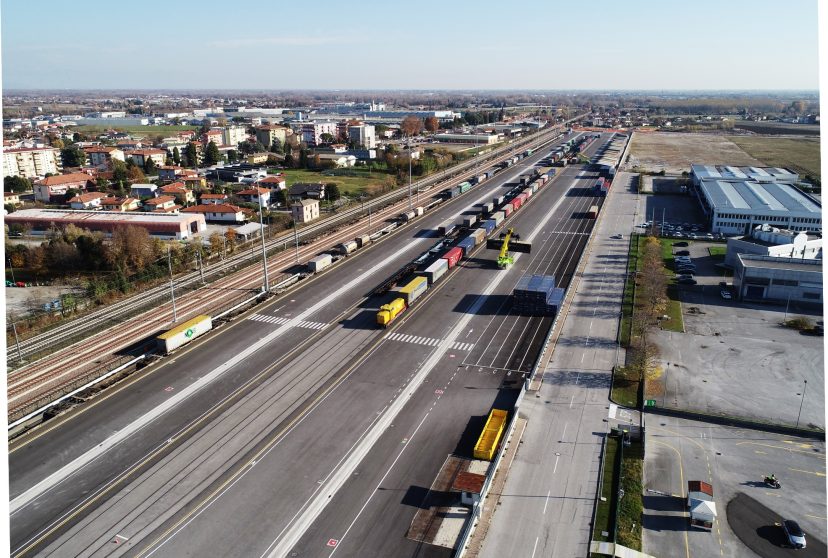
PORDENONE – A new operational phase is opening at Interporto Pordenone, with the launch of rail terminal management entrusted to InRail, which will dispatch its first train under its responsibility on 2 April.
The initiative marks the start of a trial period that should lead to the definition of the terminal’s stable management model. The main objective is to develop new rail traffic, pooling volumes from companies in the area in order to reach the critical mass needed to organise regular services.
InRail commercial director Lucio Gentile explained that the company is taking on the role of traction operator, providing locomotives, rail wagons and operational capacity to build new traffic routes. The company already operates along the main European corridors and on links with several Italian ports, offering interoperable services to Northern Europe and Eastern Europe.
InRail chief executive Martin Ausserdorfer underlined that the Pordenone hub has an interesting geographical position, both westbound – with traffic flows directed towards Piedmont and Liguria – and eastbound, thanks to its connection with Slovenia and Croatia. According to Ausserdorfer, the challenge will be to bring together volumes from several companies: it is difficult for a single business to fill an entire train, but aggregating traffic can make the rail service sustainable.
Initial contacts with the market have already shown signs of interest. Among the players that have started discussions with the terminal are also international rail and maritime logistics operators, including MSC (which is willing to continue the connection with the port of Trieste) and Hupac, the outgoing operator of the same rail terminal.
The initial management period will be limited in time. For one year and three months the terminal will be entrusted directly to InRail, while afterwards a tender will be launched for the permanent management. The model now taking shape envisages the creation of a management company in which Interporto Pordenone intends to participate as an industrial shareholder.
The change in approach was highlighted by Interporto chief executive Sergio Bolzonello, who spoke of a transformation in the role of the logistics infrastructure. The goal is no longer simply to manage spaces or tracks, but to contribute directly to the development of traffic and rail services.
The same approach was reiterated by Confindustria Alto Adriatico president Michelangelo Agrusti, according to whom the interport must become an active part of an industrial project linked to regional logistics. In this framework, the Pordenone infrastructure is also aiming to strengthen relations with the ports of the Upper Adriatic, especially Trieste, with the objective of carving out a role in the inland port system.
At the same time, infrastructure investments are moving forward. The rail shunting yard is nearing completion, while the expansion of the container depot and new parking areas have already been completed. By June, the interport’s digitalisation project should also be completed, financed with funds from the Ministry of Infrastructure and with the company’s own resources.