

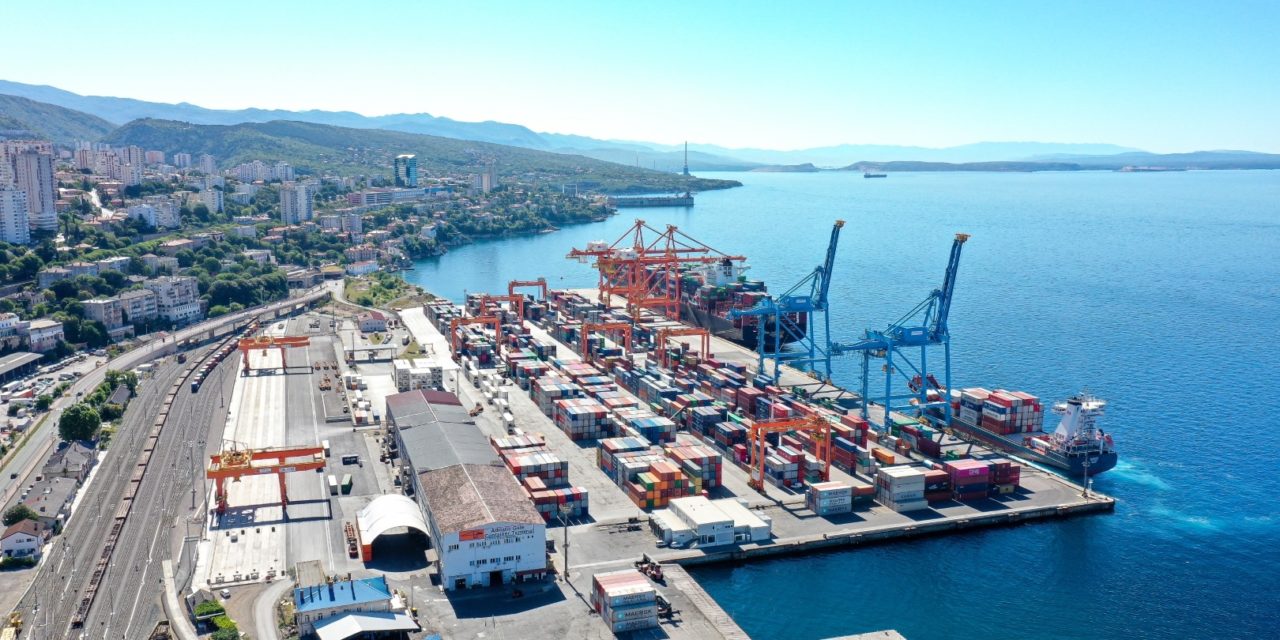
TRIESTE – In 2025 traffic at the port of Rijeka slowed, but containers and general cargo supported volumes and revenues. Overall traffic for the Luka Rijeka group, including the container subsidiary Adriatic Gate (Jadranska Vrata), stood at 5.82 million tonnes, down 5% from 6.13 million in 2024. The decline was concentrated in bulk cargo, while the handling of more profitable goods increased. Containers recorded a 4% increase in teu terms, considering that the figures for the A.P. Moller-Maersk terminal, which is not managed by Luka Rijeka, are not included.
General cargo also grew, accounting for 12% of total volumes and recording a 3% year-on-year increase. Within this category, metallurgical products stood out with a 29% increase, while new traffics such as vehicles are emerging, a segment the group is targeting to improve profitability. Negative signals came instead from some niches: refrigerated cargo declined because of changes in logistics routes, while livestock traffic fell, penalized by restrictions introduced by Croatia between April and June 2025 following outbreaks of foot-and-mouth disease in Hungary. The real element of weakness remains the bulk segment, which accounts for 15% of volumes but fell by 31% compared with 2024. The contraction mainly concerned grain, coal and scrap. The decline in grain was affected by unfavourable weather conditions and lower international prices, while coal was hit by reduced steelmaking activity and scrap by weakness in destination markets.
Financially, revenues fell by 3% to 26.6 million euros, but the effect was contained thanks to growth in higher unit-value traffic. Operating costs rose by 4%, driven mainly by labour costs (+7%), while the gross operating margin declined in percentage terms (EBITDA margin at 12.56%, down from 15.99%). Operating profit nevertheless reached 9.6 million euros, up 5%. The financial position improved, also supported by a 4.9 million euro dividend from the container company.
The workforce continues to shrink: at the end of 2025 the group had 578 employees, 8.5% fewer than the previous year. The trend is expected to continue, in line with cost containment policies and greater operational efficiency. On the investment front, the main project concerns the expansion of the Škrljevo container depot, for a total value of 5.7 million euros. The project aims to increase storage capacity and introduce new activities, including the handling of full containers. Other measures include the purchase of operating vehicles, digitalization of flows through empty-container tracking, installation of a photovoltaic plant and renewal of cranes and equipment at the terminals.
The geopolitical context – Luka Rijeka explains – remains a pressure factor. The war in Ukraine, tensions in the Red Sea and changes to maritime routes are extending transit times and increasing logistics and energy costs. For a port such as Rijeka, integrated into European supply chains, this translates into traffic volatility and the need for continuous operational adaptation.
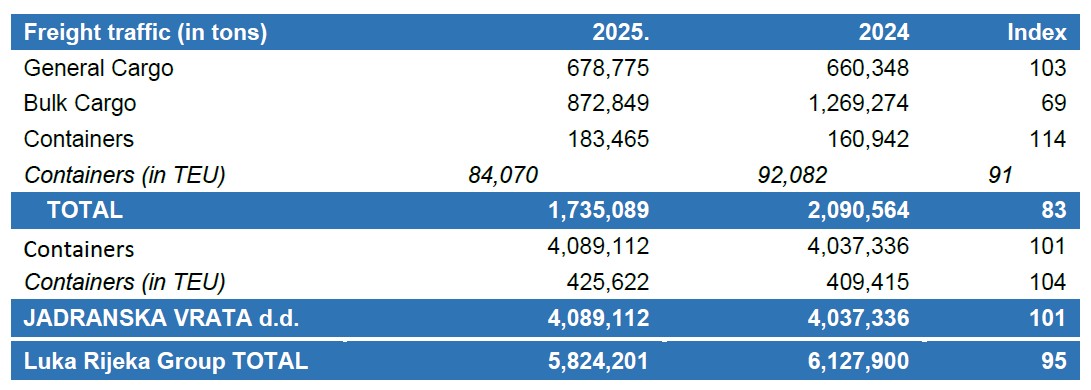
The Luka Rijeka group is the main concessionaire for dry bulk cargo at the port of Rijeka. Created through privatization in 1994, it operates in port services related to cargo loading, unloading, handling and storage, as well as mooring activities.
The company wholly controls several operating entities in road transport, property management and container storage, and holds a 49% stake in the container company Adriatic Gate, whose results contribute to the group’s consolidated financial statements.