

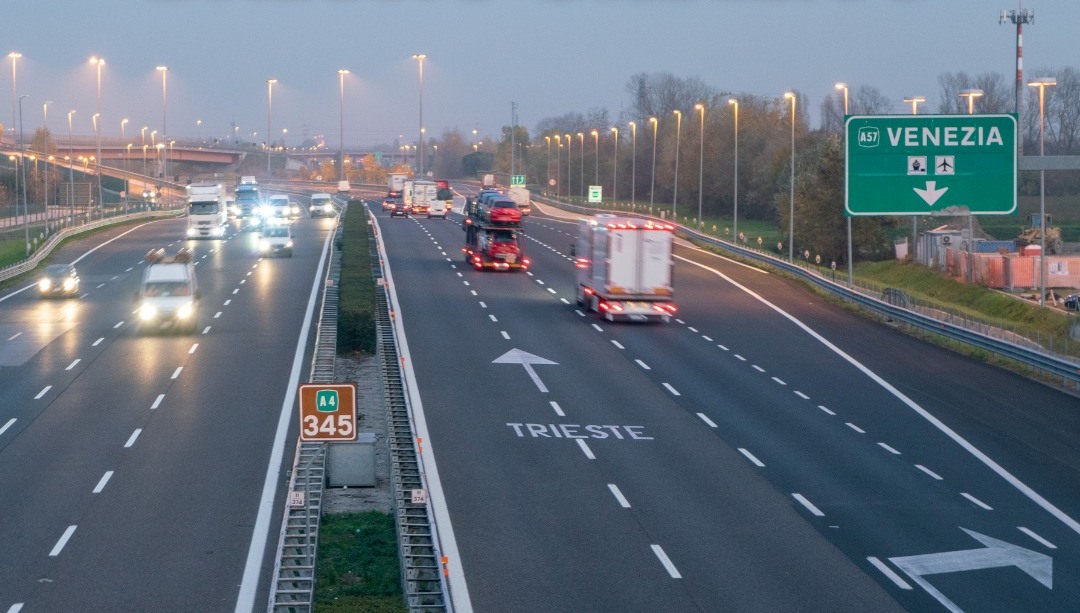
TRIESTE – The Autostrade Alto Adriatico network is set to close the year with more than 54 million vehicle passages, an all-time high that highlights the growing centrality of the East–West axis for freight movements and for tourist flows entering and leaving the North-East.
According to figures released by the Operations Directorate, overall traffic is up 4% compared to 2024, with +5% for light vehicles and +2% for heavy vehicles. On the Portogruaro–San Donà stretch — still two lanes pending the third lane planned by 2026 — growth ranges between 2% and 3%, while heavy vehicles remain below 1%. The evolution of the past twenty years is clear: the network has risen from 35.8 to more than 54.2 million transits, and from 1.6 to around 2.8 billion kilometres travelled.
For President Marco Monaco, these figures confirm that the Alto Adriatico corridor has become Italy’s main East–West route for freight flows, chosen by businesses for productive connections and by Italian and foreign travellers heading to the region’s tourist destinations. Growth is also linked to the development of the third lane, now extended across roughly 60 kilometres, 40 of which built since 2021. This upgrade has significantly improved traffic flow from Trieste to Venice, strengthening access to logistics hubs and coastal destinations.
On the safety front, the data show structural improvement. Injury accidents have fallen by two-thirds compared to twenty years ago, dropping from 11.5 to 4.5 accidents every 100 million vehicle-km over January–October. The Portogruaro–San Donà section also records for the first time a value (6.19) slightly better than the average of other concessionaires (6.2). Total accidents fell from 461 to 396, and those on the critical stretch from 94 to 86. Fatal accidents across the whole network declined from 9 to 5, with a single case between Portogruaro and San Donà.
According to the concessionaire, the improvement stems from measures introduced jointly with the Traffic Police on speed control, safe distances and technological monitoring, which have helped stabilise the network even during periods of peak traffic.