

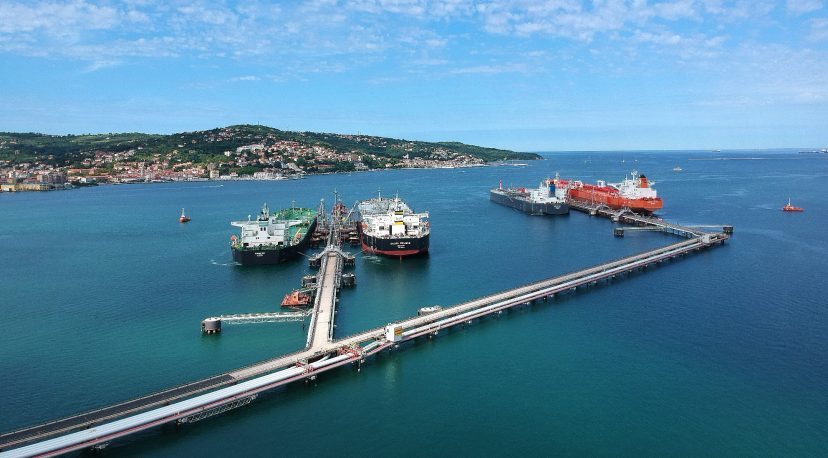
TRIESTE – According to SIOT–TAL, the conflict affecting the Iran area is not currently showing any material effects on crude-oil flows handled at the Marine Terminal of Trieste.
An analysis of the origins of crude volumes handled in 2025 by the SIOT–TAL system, which operates the Transalpine Pipeline, shows that only a marginal share of cargoes transits along routes potentially affected by the ongoing conflict in the Iran area. The company therefore estimates that, at present, there is no evidence of a significant potential impact on traffic at the Trieste terminal or on operations.
More specifically, of the roughly 41.5 million tonnes of crude unloaded in 2025, only cargoes originating from Iraq (6.9%) and Saudi Arabia (5.3%) travel along routes that could be affected by the crisis. Overall, this amounts to about 12.2% of the total handled last year, indicating relatively limited direct exposure. The bulk of the supply mix is instead secured—around 70%—by crude from Kazakhstan (34%), Libya (25%) and Azerbaijan (11%), which follow routes entirely outside the tension area. This geographic diversification of sources is described as a stabilising factor for Central Europe’s energy supply system.
“The oil market has historically shown considerable resilience and an ability to adapt to geopolitical tensions. The flexibility of international flows, combined with the diversification of our shippers’ supply sources, allows us to take a pragmatic view of how the situation may evolve,” the company said. SIOT–TAL is meanwhile continuing to monitor developments, ensuring the Trieste terminal remains operational and supplies continue to the refineries in Central Europe served by the Transalpine Pipeline.
«We are closely monitoring developments in the Middle East. At present and in the short to medium term, TAL’s direct exposure remains limited, although continued disruption to inbound and outbound flows through the Strait of Hormuz will have knock-on effects in the future. Our infrastructure,” confirmed TAL CEO Alessandro Gorla, “is designed to handle a wide range of crude grades from multiple geographic sources— in 2025 alone, we received more than 40 different crude grades and more than 260 since we began operations. While most of our supply currently comes from Libya, Kazakhstan and Azerbaijan, whose maritime routes lie entirely outside the affected area, this diversity and flexibility is a key strength of our system».