

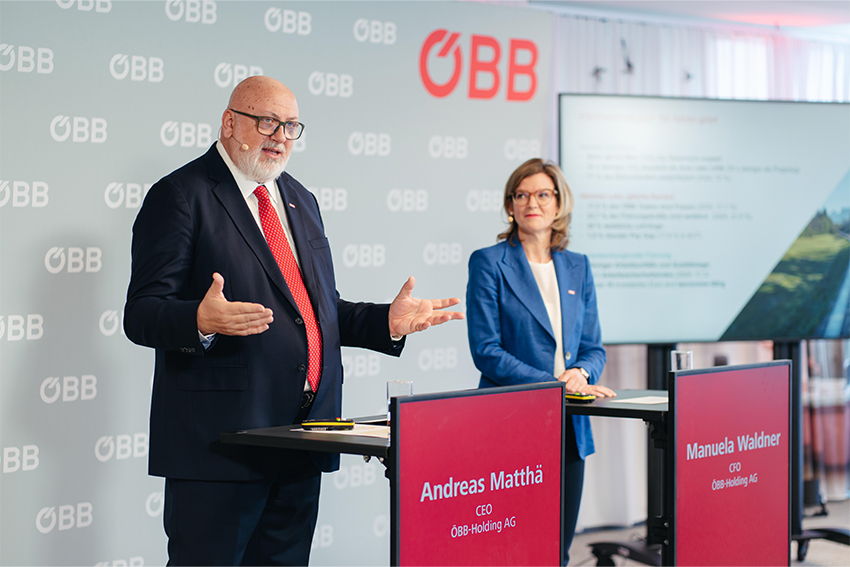
TRIESTE – 2025 ended in the red for ÖBB Rail Cargo Group (RCG), penalised by weak market conditions in the main European countries and by an increasingly complex competitive environment for rail freight transport.
Over the past two years, Central Europe has entered a phase of industrial recession that has directly affected transported volumes.
The contraction in demand has been accompanied by growing competitive pressure in the logistics sector, where a large number of operators are competing for increasingly limited cargo volumes. At the same time, rail transport continues to suffer from a structural disadvantage compared with road haulage, aggravated by high energy costs and intensive construction works on the network, particularly in Germany, which affect operational regularity.
In economic terms, RCG recorded a pre-tax result (EBT) of -135.5 million euros, a sharp deterioration compared with -24.5 million in 2024. The figure was largely influenced by an extraordinary impairment of 81.1 million euros linked to investments in Hungary and the agricultural sector. Even excluding this component, the result would still be negative by around 54 million euros.
The agricultural segment had a particular impact, generating losses of around 36 million euros due to weak harvests, changes in trade flows and distortions linked to international tariff policies. In a context that shows no signs of recovery in the short term, the group has launched the “Phoenix” efficiency programme, which includes around 300 measures, including the rationalisation of the offer, an increase in the utilisation rate of the most in-demand routes and organisational simplification. According to management, maintaining service quality remains central.
Despite the difficulties, RCG confirms its medium- to long-term investment strategy, focusing on innovation and intermodal integration. Among the key projects is the development of Digital Automatic Coupling (DAC), a technology designed to improve the efficiency of rail freight transport. At the same time, the group is continuing to strengthen multimodal solutions, with the aim of making the system more competitive and resilient in the European context.