

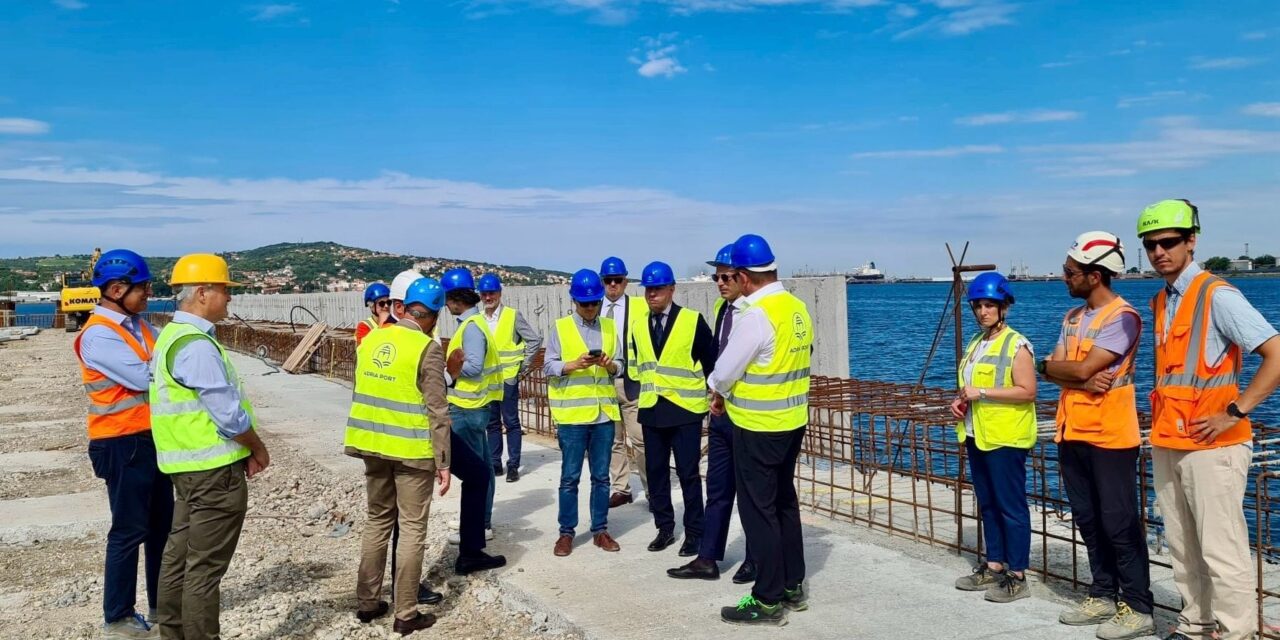
TRIESTE – The construction site of the new quay for the Hungarian terminal in the Port of Trieste was visited in recent days by the Director General of the Ministry of Infrastructure and Transport, Donato Liguori, accompanied by the Secretary General of the Eastern Adriatic Sea Port Authority, Natale Ditel. The inspection focused on the progress of the maritime infrastructure, which is now nearing completion.
The visit is part of the series of inspections Liguori is conducting across Italian Port Authorities to verify the progress of works funded by the National Recovery and Resilience Plan (PNRR) and the Complementary Fund. In Trieste, however, it also holds a special significance: prior to the appointment of Marco Consalvo as head of the Authority, it was Liguori himself who served as the Extraordinary Commissioner of the body.
During the day, the Director General also visited other port construction sites supported by resources from the National Complementary Plan and the PNRR, dedicated to upgrading infrastructure at the Friuli Venezia Giulia port.
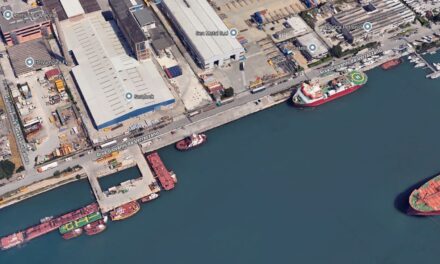
Regarding the Hungarian terminal, the inspection comes at a stage where public works are adhering to the timeline, while there is still anticipation for the start of private investments planned by Adria Port, the company controlled by the Hungarian state that will build and operate the new multipurpose terminal. On the maritime side, the quay construction funded by the Complementary Fund to the PNRR is now nearing completion, while in the area behind it, construction work on the future operational infrastructure is not yet visible.
The overall project involves an investment of approximately €200 million for the construction of a multipurpose terminal intended for container, Ro-Ro, general cargo, and project cargo traffic, covering an area of about 32 hectares at the former Aquila refinery. Once fully operational, the infrastructure will be equipped with approximately 650 meters of quay and direct rail and road connections, with the aim of providing Hungary with a logistics outlet on the Adriatic and strengthening trade links with Central Europe.
In recent months, the project has seen several steps forward on the public side. In addition to the work on the first phase of the quay, the Port Authority has also started the design of the second phase, aimed at further expanding the berthing front of the future terminal.
It remains to be seen, however, when private investments on the land areas will concretely begin, which are awaited by operators as the decisive step to transform the infrastructure site into an operational terminal.