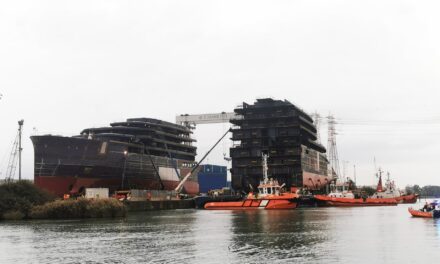


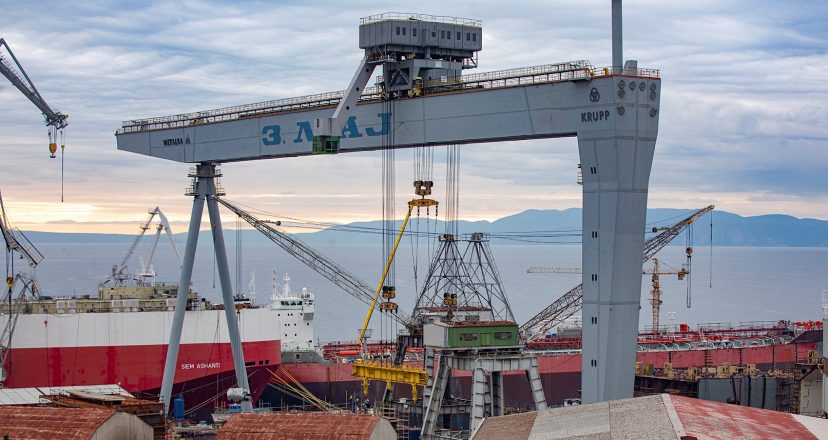
TRIESTE – The Slovenian Iskra group is stepping up efforts to relaunch Rijeka’s “3. Maj” shipyard with an initial plan for immediate investment.
According to Novi List, owner Dušan Šešok has indicated urgent measures worth between 5 and 10 million euros for machinery and equipment, needed to support production in the short term. This is the first phase of a broader programme which, in the medium to long term, could exceed 100 million euros, though this is tied to the renewal of the concession beyond 2031.
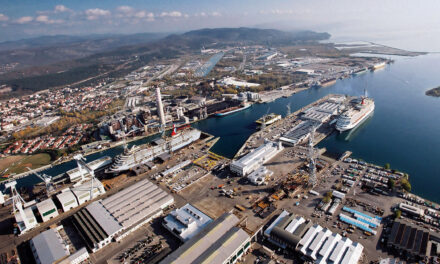
The starting picture remains critical. The industrial site covers more than 500,000 square metres but suffers from structural shortcomings: obsolete equipment, deteriorated infrastructure, low productivity and a shortage of skilled labour. The shipyard is reporting monthly losses of around 500,000 euros and needs new contracts to ensure production continuity already in the short term.
The new shareholder’s strategy is based on three lines of action. The first is filling the orderbook: Iskra says it has already received numerous enquiries for commercial vessels and is aiming to secure new contracts within six months. The second is internal reorganization, with particular attention to the roughly 440 employees, in order to improve efficiency and cost control. The third concerns a shift in operating approach, with an explicit focus on productivity, seen as one of the main factors behind the crisis in Croatian shipbuilding.
On the financial side, Šešok rules out direct state support in the short term, but points to a change in direction at European level, with the opening up of support instruments also for the shipbuilding sector, which until now has been excluded compared with other industrial segments. The concession issue remains central. Its renewal for a further 20 years will be a necessary condition for triggering the larger investments and will require a complex process, already experienced by the group at the Šibenik shipyard, involving bank guarantees and detailed plans.
On the industrial side, the deal is not tied to military programmes. The group says it did not make the acquisition conditional on the construction of corvettes for the Croatian Navy, while still maintaining an interest in any future tenders. The focus remains on civilian ships, considered sufficient to support the shipyard’s relaunch.
At the same time, Iskra says it is open to cooperation with other operators in the Rijeka area, with a view to local industrial integration. Among the priorities is also the strengthening of technical skills, with the possible recruitment of new engineers and support from the design team already active at the Šibenik shipyard.
However, further statements later made by Šešok point to an even clearer line: the relaunch will depend on a radical change in management approach. The new owner rules out an approach centred on socially driven employment support and instead identifies efficiency, individual responsibility and operational discipline as the key criteria. The objective remains rapid: to bring the shipyard at least to break-even within a few months, supported by new orders and internal reorganization.