

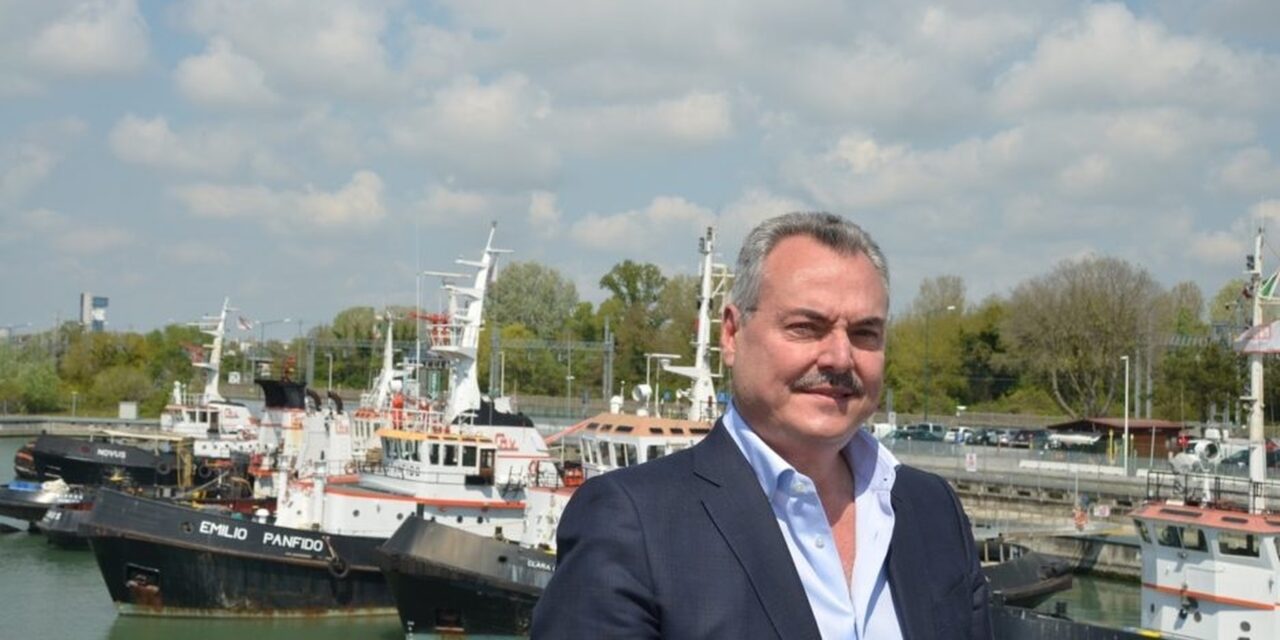
VENICE – In light of the new developments expected for the Port of Venice, as announced by Deputy Minister for Transport Edoardo Rixi, we asked Davide Calderan, president of the Venice Port Community, for his view. The port community represents the operators of the Venetian port, which generates a significant economic ripple effect in the North-East and across Italy, but which also has to deal with an ongoing regulatory framework.
Porto Marghera is at the centre of investments in terminals, electrification and sustainability. From the operators’ perspective, how much are these measures already affecting day-to-day operations?
«The investments made in the recent period come from local companies and multinationals with interests in Italy and worldwide. This is real proof that private players are betting on the Port of Venice and see it as a growing economic reality, important for the North-East and for all of Italy. The impact is very concrete and we can already see an increase in port traffic. Just think of the new cargo handling that will be made possible thanks to the new Tencara Terminal (in the South Canal of Porto Marghera, ed.), just to mention one. In addition, the new cranes that Vecon has recently installed, and the investments continuing in other terminals, will certainly bring greater efficiency and faster ship turnaround, increasing the economic spin-offs generated by our port».
Venice is going through a transition phase, between industrial relaunch and environmental constraints. Today, what is the hardest balance to manage for those who work in the port?
«Without doubt, the most demanding issue is the management of the MoSE. It is essential to start from a well-planned approach, shared with all the stakeholders involved. Beyond that, the estimates and weather forecasts must be assessed very carefully, in order to optimise the times for raising and closing the gates. This way, it will be possible to avoid unnecessary closures, while still ensuring the right level of protection for the city. We believe it is important to complete the investments needed so that the fixed threshold—110 centimetres above sea level—is respected, and Venice and its residents can live properly. As port operators, we are the first to want to safeguard the lagoon, because we live in synergy with this variable. Optimising the lifting schedule would bring an undeniable benefit to the port, while also keeping MoSE maintenance costs under control, at the centre of the ministerial debate these days».
The issue of nautical accessibility and seabed depth remains central. Do operators perceive a real improvement, or does uncertainty still prevail?
«Certainly, until all the projects submitted by the Venice Port System Authority are approved, there will be an element of uncertainty. For many years we have been kept in limbo and, as President Gasparato said, it is time to change approach. The approval of the new island for dredged sediment storage is a first reassurance that helps us think we are on the right path, and it clearly helps to bring down the level of uncertainty».
Marghera and Chioggia have different, but complementary roles. How can this relationship evolve to strengthen the overall system, without overlaps?
«The two ports must always work in harmony, as if they were a single reality. For example, Chioggia can be complementary to Venice for activities that require different spaces compared to what Venice can currently offer. To give one case, Cimolai in Chioggia is investing to provide assembly and shipping services for cranes or specialised structures. Moreover, Chioggia can receive smaller vessels—whether dry cargo or cruise ships—offering a wider range of opportunities to users. In both cases, the two realities do not overlap: they bring benefits to the wider economy and to the supply chain around both ports, which little by little, in fact, need to take a shared path, under the logic of one single system. It is no coincidence that the port authority’s official name includes the wording “Ports of Venice and Chioggia”».
Looking at the next few years, what is the strategic choice the Port of Venice must make to remain competitive in the Northern Adriatic?
«First of all, Venice needs all the projects requested by the Port System Authority to be approved by the Government: maintenance of the Malamocco–Marghera canal, the Canale Nord cruise terminal, the Montesindial terminal and the dredging of the Vittorio Emanuele canal. Then, it will be necessary to manage the MoSE efficiently, by carrying out the investments for the city as I said before. Finally, in the long term, it is right to start thinking about the offshore terminal, even if first we must complete all the investments needed to address the present».
Deputy Minister Rixi spoke about rules for a “regulated port”. Where are we at? Will you be directly involved in drafting them?
«As agreed with Deputy Minister Rixi and Minister Matteo Salvini, together with the Harbour Master’s Office, the Port System Authority and the Lagoon Authority we will submit a proposal on the Regulated Port by the end of January. Then we will be available to discuss it with the Ministry, with the intention that it will be included in the port reform».